
Do you have a Religious Plaque or Panel by George Tinworth of Doulton Lambeth?
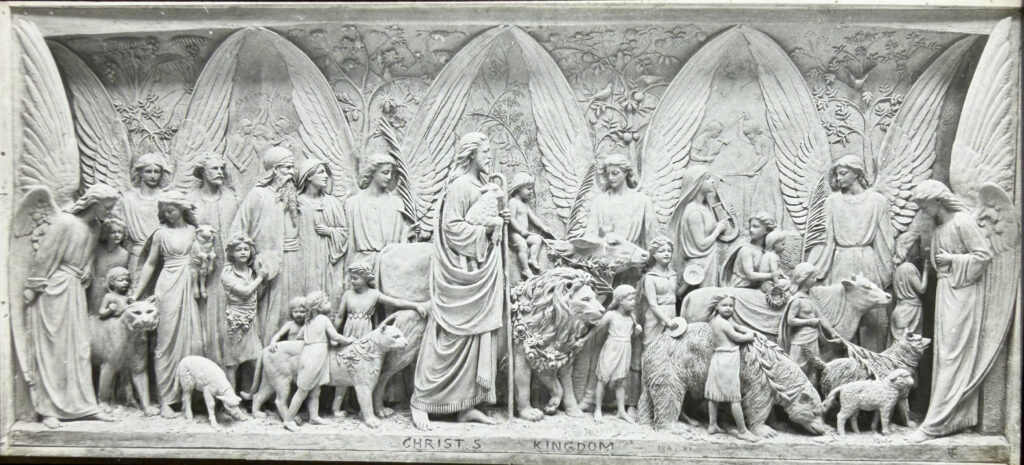
Christ’s Kingdom by George Tinworth
George Tinworth was a well known artist for Doulton Lambeth in the late Victorian to early Edwardian period. Most people know him for his vases or his whimsical mice and frogs, but he also produced Christian religious plaques and panels in both large and small forms. Large forms were for chapels, churches and cathedrals, where to this day some of his panels can be seen. He also created small versions, for Christians to display in the home or for churches and chapels to use in smaller rooms and settings.
A brief background to his plaques and panels
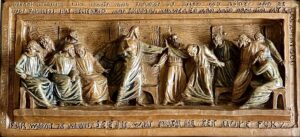
The Incredulity of St Thomas, George Tinworth, 1874-78.
Mediums – George Tinworth was an ardent Christian who was strongly influenced by his mother who was a Quaker. He was well versed in the books of the Bible, and soon put his skill towards creating Christian, religious objects once he started at the Doulton Lambeth studio. In the early days, George experimented with making plaques in stoneware which he added typically cobalt blue colour to and glazed. An example of such is a plaque, illustrating Doubtful Thomas as he stands before Jesus, is provided here to the left.
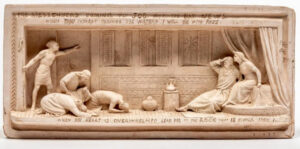
The Messengers come to Job, George Tinworth, 1874-82
As time passed towards the late 1870s, George Tinworth found himself creating his plaques and panels in both stoneware and terracotta. Terracotta he found easier to work and more refined to bring out the smaller details in the small plaques, whereas stoneware is a harsher medium and more difficult to achieve detail with. It is quite common to find the identical plaques created to the same size in both stoneware and terracotta. We are not sure how many he made of each plaque or panel as there are certainly known duplicates of many out there to be found. The terracotta was not glazed. Occasionally, one can observe limited use of white paint to highlight garments, head dress or jewellery. An example is provided to the right. Job’s wife’s necklace is painted white. Later through the 1880s to his death, he primarily focussed on terracotta plaques and stopped stoneware versions.
Religious Text and scope – It is very common for religious texts to be quoted around the scene. Most large rectangular panels will show quotes that are from the King James Version of the Bible. Smaller square plaques may just have a religious title and maybe a Bible book reference, but no quotes. In the examples above quotes can be seen clearly on both, often wrapping around the edges of the plaques. Sometimes quotes may even appear in the decorated scene. Whilst not common place, George Tinworth sometimes added his own comments to the plaques. These can be quite humorous or direct, showing his opinion of the subject being portrayed very clearly. Occasionally, there will be spelling mistakes as George Tinworth came from very modest means and grew up in poverty. Consequently he was not highly literate through formal education. From a scope perspective, George Tinworth was very prolific across both Old and New Testaments, and he often chose a scene from one, but then inscribed quotes from both to speak prophetically to the coming Christ.
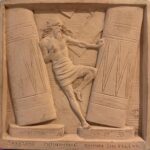
George Tinworth, Samson Throwing Down the Pillars
Relief-work – George Tinworth created his plaques and panels in two formats. Firstly is his signature technique we simply refer to as deep relief. With this technique, the figures are fully sculpted into the clay or stone, which creates huge depth to the piece. This was both acclaimed and criticised in the day by art experts as having wonderful effect, but also missing the classical school of finer relief work. The second is bas-relief, where the relief work is far flatter and more classical in its execution. These are most often seen in his smaller square plaques, although he did create larger bas-relief plaques. An example of bas-relief is to the left, showing Samson throwing down the pillars.
George Tinworth
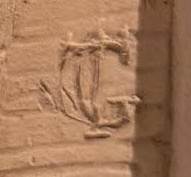
How do I know I have an authentic plaque? – There are a few things you can check to make sure your plaque is authentic. Firstly, check for his initials “GT” that were signed in a similar fashion to the logo of this website. See to the right for an example. At times, he signed his full name beneath the scene at the bottom left or right. Secondly, there is a good chance there is a reference to Doulton Lambeth. He inscribed the words “Doulton Lambeth” by hand. On later plaques, the edges or rear of the plaque can be stamped with a Doulton Lambeth stamp. You should be confirming by visual cues that it is either glazed stoneware or terracotta. He did not use plaster or other mediums. It is perfectly normal for there to be white (almost plaster like in colour) terracotta to deep pink terracotta. Lastly, the plaques were generally all hand-finished so you should be seeing the crisp incision marks of his clay instruments. A copy in plaster will lose its crisp edges.
Have a plaque to sell or value?
We will be delighted to provide a fair valuation, or we can offer to buy it. We have significant knowledge in valuing these pieces. International shipping is not a problem and we are equally experiencing at arranging and guiding sellers in this regard.
Phone or Whatsapp us on (+44) (0) 7850210032 to receive a valuation or to discuss selling your plaque.
Alternatively you can email us at info@gt-artpottery.com or through our contact page
Some further resources:
Buy with confidence
We stand behind the authenticity and condition of our collection
We get your passion and interest
Like you, we are deeply passionate and enthusiastic about period British art pottery
Collecting is all about fun
You should have fun collecting, so GT Art Pottery strives to make your experience fun and easy
