-
Out of stock
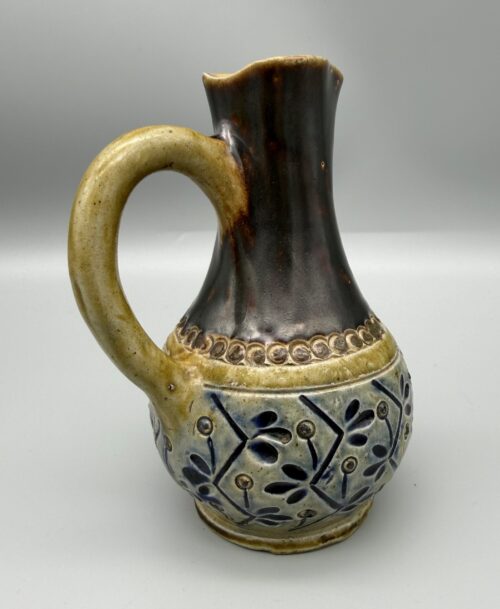
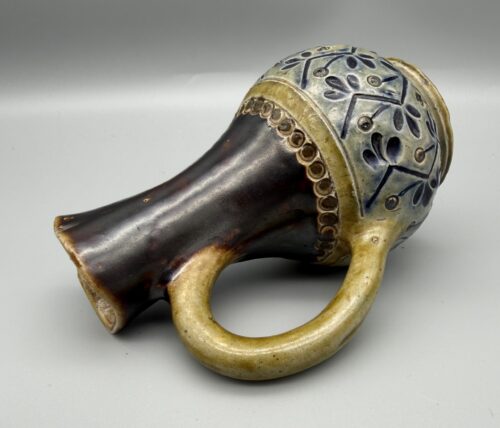 Martin Brothers Early Stamped Small Jug For sale is this truly delightful early Martin Brothers jug, dated 23-06-1880. Rare to find, this jug is stamped with the early "R.W. Martin Southall" stamp which dates it authentically to 1880. To the top half, the jug has been coloured with a mix of rich brown and light metallic oxides to give the brown an additional sheen to it. Beneath, bandings of small circles and lines separate the brown top section from the framing of the zig-zag simple foliate and flower desgned motifs. A subtle olive-green presents in the centre bandng and onto the jug handle for further contrast to this wonderful early piece. Beneath, the R.W. Martin Southall" stamp is clear as well as the hand-inscribed date of 23-06-1880. This piece is in wonderful orginal condition and is free from any chips, cracks or repairs. It measures 14cm tall by approximately 10.5cm wide including the handle. This is Martin Brothers in its simple authenticity, in wonderful condition. Adding it to your collection will not disappoint and it is a lovely size for a cabinet.
-
Out of stock
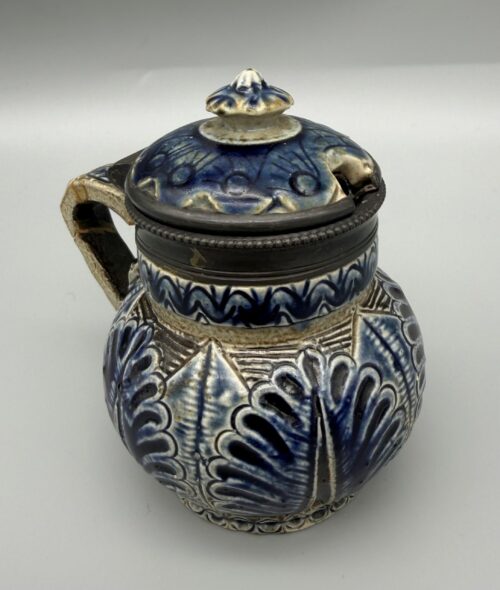
Early R.W. Martin Salt-Glazed Mustard Pot (April 1874)
This historically significant salt-glazed mustard pot, measuring 9cm in height and width, represents a rare early work by Robert Wallace Martin. Dated to April 1874, the piece features a squat, bulbous body transitioning to a structured neck and a domed lid with a sculpted finial. It retains its original pewter metal hinge mount, complete with a traditional spoon aperture.
The vessel is heavily decorated, utilizing a deep cobalt blue glaze that contrasts sharply with the textured buff stoneware ground. The exterior displays a vigorous, deeply incised pattern of stylized foliate and fern-like motifs around the lower body. This is complemented by a continuous band of repeating wavy arches at the neck and radiating petal designs upon the lid.
The underside bears the clear, incised signature "R W Martin", alongside the pattern code "A36" and the date "4-74", firmly placing its production in the pivotal early months of Wallace's independent career.
Condition & Restoration Opportunity: While the main body, metal mount, and lid present strongly, the angular handle has sustained four breaks and currently exhibits old, crude adhesive repairs. This presents an excellent, straightforward project for a professional ceramic restorer or a dedicated collector. Once sympathetically restored, this piece will stand as a highly displayable and historically important 1870s artifact.
-
-25%
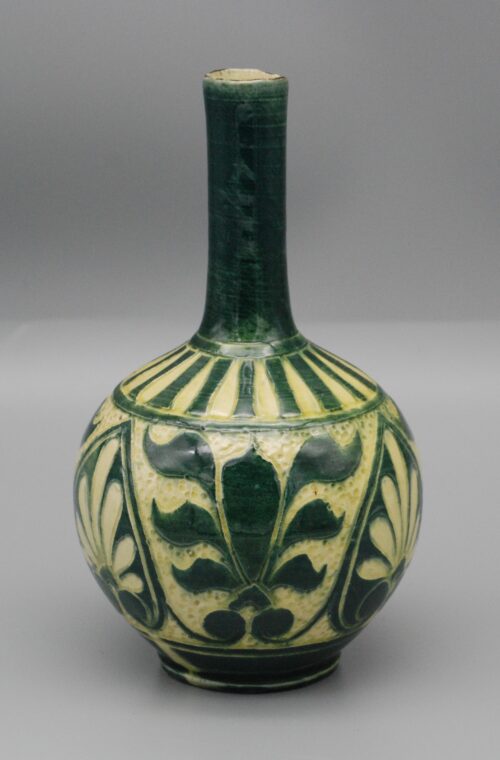
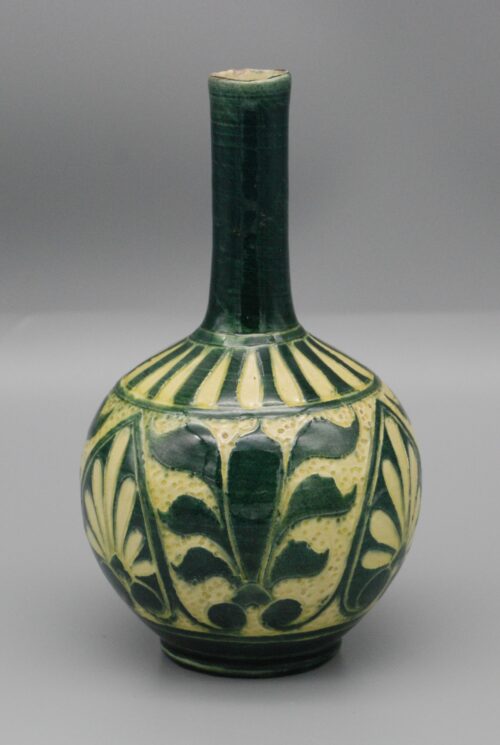
C.H. Brannam Barum Sgraffito Bottle Vase (1890)
This striking bottle vase, measuring 15.5cm in height and 8.5cm in width, is a fine representative example of the distinctive sgraffito ware produced by C.H. Brannam at the end of the 19th century. Dated 1890, the vessel is defined by a classic globular body that sharply transitions into an elongated, slender neck, resting upon a short, neat foot rim.
The tactile surface showcases a highly disciplined use of the sgraffito technique, juxtaposing a rich, glossy forest green glaze against a pale, cream-colored stippled ground. The decoration is strictly structured: the shoulder features a bold, radiating striped motif that anchors the base of the neck. The primary body is divided into panels by sweeping, arched green borders that frame stylized, symmetrical botanical and palmette designs. The intricate stippling of the negative space provides substantial depth and texture, typical of Brannam's best art wares.
The underside bears the clearly incised signature "CH Brannam Barum 1890", firmly dating its production. The vase presents in excellent antique condition, retaining a vibrant and lustrous glaze. There is a minor 4mm nibble to the interior of the top rim, which is historically consistent with the fragile nature of the earthenware body and does not detract from the piece's strong display presence.
-
Out of stock
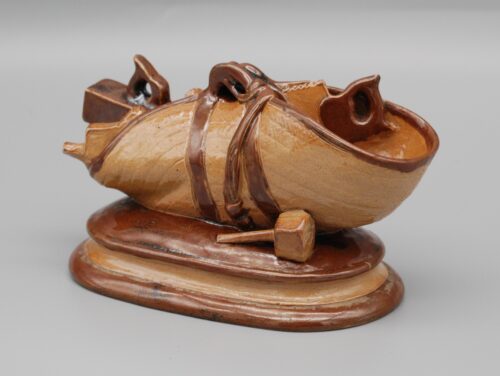
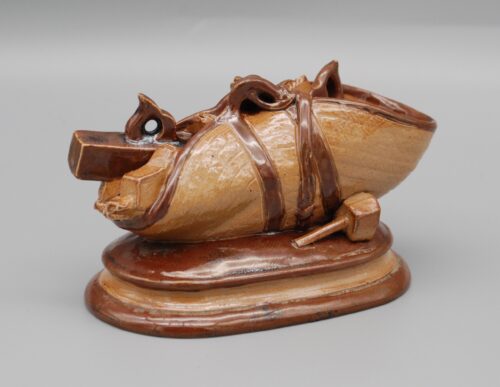
Rare George Tinworth for Doulton Lambeth – Stoneware Model of a Carpenter’s Bag (c. 1880s–1890s)
This finely modelled stoneware study of a carpenter’s bag is a superb example of the whimsical yet highly skilled designs created under the direction of George Tinworth for Doulton Lambeth in the late Victorian period. Measuring approximately 13.5cm in length and 8.5cm in height, the model is remarkable for both its craftsmanship and detail.
The body of the bag is finished in a warm creamy light brown glaze, while the edges, straps, and handles are picked out in a contrasting darker hue, emphasising the form and adding depth. One side of the bag is richly decorated with Victorian-era woodworking planes, while the opposite side, open and more restrained, reveals only a woodsaw within. On the integrated stoneware plinth, tools of the trade—a mallet to one side and a chisel or file to the other—are carefully arranged, grounding the piece in the world of the Victorian craftsman.
This model captures Tinworth’s hallmark ability to combine utility, charm, and social observation in a single work of art. Pieces such as this, with their humour and realism, were often intended as conversation pieces and today are regarded as rare and highly sought-after examples of Doulton Lambeth artistry.
The base carries the impressed Doulton Lambeth circular mark, together with the initials “EMW”—likely one of the assistants or moulders working under Tinworth’s direction—along with the registration stamp “Rd” and the series number 162583. The piece remains in excellent, unrestored condition, free from cracks or repairs.
A wonderful and rare George Tinworth study, this model exemplifies the creativity and craftsmanship of the Doulton Lambeth workshops at their height and represents a fine acquisition for the discerning collector of Victorian stoneware and Tinworth’s celebrated oeuvre.
-
Out of stock
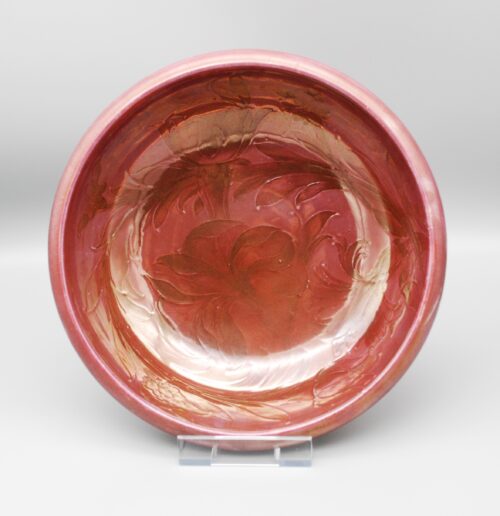
Extremely Rare William Moorcroft Flambé Bowl – Spanish Pattern (c. 1910–1916)
This exceptionally rare flambé bowl is a remarkable example of William Moorcroft’s artistry and experimental mastery during the early Burslem period. Measuring 23cm in diameter and 7cm in height, the bowl is decorated in the highly desirable Spanish pattern, one of Moorcroft’s most striking floral designs, introduced around 1910 and produced only for a short period.
The interior reveals the hallmark tubelined decoration, with three large Spanish flowers at the centre and four medium blooms gracefully arranged around the upper edges. The exterior continues this flowing design, displaying three further large flowers evenly distributed around the circumference. The entire piece glows with a rich, iridescent pinkish-red flambé glaze, a finish Moorcroft frequently undertook personally in his kiln experiments. On this example, subtle overfiring to one side provides both visual depth and a tangible reminder of its experimental origins.
The underside is especially striking, showing intense iridescence with oily rainbow hues, reminiscent of a delicate film of light across a surface—an effect unique to flambé glazes of this period. Beneath, the bowl bears no painted signature, though its authenticity is undisputed, confirmed by its important provenance as part of the Moorcroft Museum Collection, where it was catalogued and retains its original label: “Moorcroft Museum, 00461.”
The Spanish pattern itself is historically significant, reflecting William Moorcroft’s early exploration of bold, stylised floral motifs, influenced by the Arts and Crafts movement and Art Nouveau aesthetics. Produced only in the early 1910s and in relatively small numbers, Spanish pattern pieces are today exceptionally rare, with flambé-fired examples being among the most coveted of all early Moorcroft works.
This superb and rare bowl, with its museum provenance, flambé glaze, and iconic Spanish design, represents a true collector’s piece—an opportunity to acquire an object of both aesthetic beauty and considerable historical importance within the oeuvre of William Moorcroft.
-
Out of stock
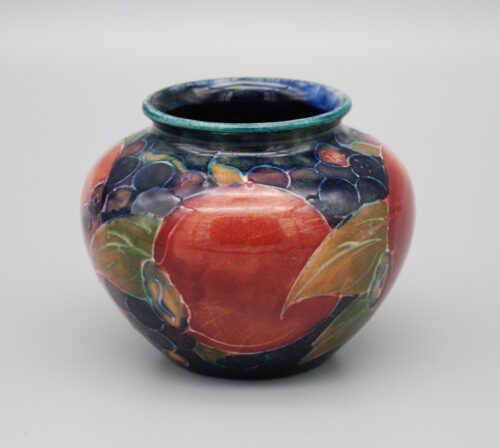
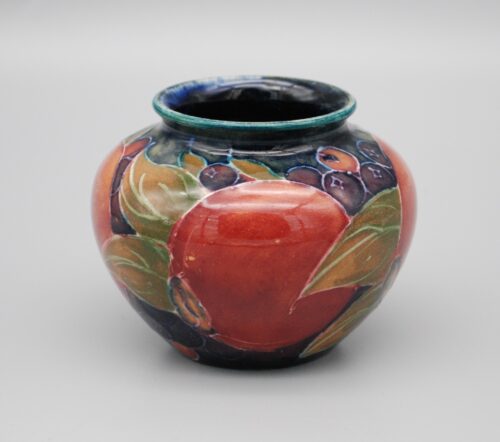
William Moorcroft Pomegranate Vase – M55 Shape (c. 1910s–1920s)
A beautiful example of early William Moorcroft craftsmanship, this small Pomegranate design vase embodies the timeless charm of Moorcroft’s celebrated Burslem period. Measuring approximately 6.5cm in height and 8cm in width, the vase is modelled in the distinctive M55 shape, perfectly proportioned for display.
The decoration features four richly painted pomegranates, evenly spaced around the rounded body, each enhanced with deep green foliage and clusters of blue-purple berries that provide a striking contrast. The design is crowned with a warm ochre glaze running up to and including the rim—an unmistakable hallmark of Moorcroft’s early Burslem output.
To the base, the vase bears a full William Moorcroft signature in green, together with impressed marks reading Moorcroft, Burslem, M55. The piece remains in excellent, unrestored condition, showing only the fine glaze crazing typical of early Moorcroft pottery, with no damage or repairs.
A lovely, well-balanced example of William Moorcroft’s iconic Pomegranate design, this vase would make a fine addition to any Moorcroft collection or serve as a statement piece in its own right.
-
-17%


William Moorcroft “Claremont” Vase – Shape M55, c.1925
A vibrant and highly desirable example of one of Moorcroft’s most celebrated patternsThis exquisite M55-shaped William Moorcroft vase, dating to the mid-1920s, showcases the iconic Claremont pattern—one of the most sought-after designs in the Moorcroft repertoire.
Encircling the body are ten finely tubelined toadstools, rendered in vivid and varied tones: four rich reds, four warm yellows, and two deep, velvety blues. Each cap is detailed with Claremont’s hallmark speckled surface and beautifully defined gill undersides—an artistic hallmark that makes this pattern so visually captivating. The base colour merges lush green and inky blue glazes, creating a moody, woodland atmosphere that complements the naturalistic subject matter.
To the underside, the vase bears the impressed marks “Moorcroft” and “Made in England”, along with the model number “M55”, confirming its authenticity and period origin.
A small, invisible professional restoration has been carried out to the top rim, precisely between a large yellow and large red toadstool. The restoration is of a high standard, with only a subtle uniformity of colour betraying the repaired area under close inspection. Importantly, the most visually dominant red toadstool sits on the opposite, untouched side, making this piece an outstanding display example.
Compact in scale but striking in design, this Claremont vase is a true collector’s gem—a perfect representation of Moorcroft’s artistry during the golden period of British Art Pottery.
Dimensions: Height: 7cm; Width 8cm
Condition: Professionally restored rim; still displays beautifully -
Out of stock

Antique Doulton Lambeth Jug by Florence Barlow, Dated 1874
An exceptional early work by a pioneering female artist of the Victorian ceramic movementThis distinguished Doulton Lambeth stoneware jug, dated 1874, is a rare and early example of the artistry of Florence Barlow, one of the most important female designers of the Doulton studio and sister to the renowned Hannah Barlow.
The jug features a finely detailed upper register adorned with seven sensitively modelled horse heads, each emerging from the clay in low relief and encircled above and below by delicate beaded borders. The rendering of the horses—marked by expressive line and form—is particularly notable, as Florence would soon transition to specializing exclusively in birds, leaving animal subjects like these to her sister, Hannah. This piece therefore captures a brief and significant phase in her artistic development.
The slender neck and lower body are decorated with stylized blue foliate sheaf motifs, set within zigzag and florette borders, creating an elegant interplay of texture and design across the jug’s surface. The decorative vocabulary is restrained yet dynamic, reflecting the sophisticated aesthetic typical of early Doulton Lambeth wares.
To the base, the jug bears the oval Doulton Lambeth impressed mark with the date 1874 to centre, alongside an early version of Florence Barlow’s personal monogram, confirming its authenticity and origin.
This piece stands as a rare and important example of early Doulton art pottery and of Florence Barlow’s formative work. It would make a significant addition to any collection of 19th-century British ceramics or women’s art pottery.
Dimensions: Height: 23cm ; Width: 14cm
Condition: The jug has had an older restoration around the rim, where the blue rim border has been repainted. This has been done to a fair standard but due to the age of the repair, there is some age crackling to the restoration. Three florettes have nibbles or chips. Other than this, the vase is untouched. -
Out of stock
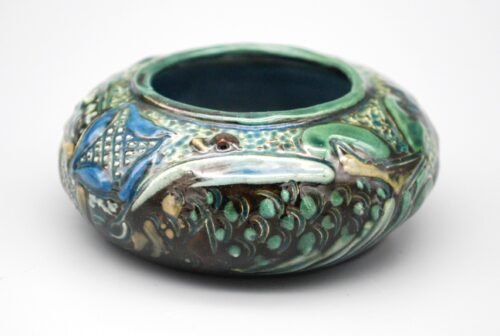 For sale we this delightful and cute little CH Brannam "open salt" decorated with two surprisingly detailed fish dating to 1901. This is the work of Frank Thomas, one of the better known artists for the potter. The fish are surrounded by various colourful waterplants. It is a little gem of a piece. Condition Offered in excellent original condition with no chips, cracks or restoration. Authenticity For authenticity, beneath, we have the registration number of CH Brannam, "Rd 44561", the signature CH Brannam Barum, the signature "FT" signifying the work of Frank Thomas and the date 1901.
-
Out of stock
 For sale we have this outstanding quality Hannah Barlow biscuit barrel decorated with six cats in various states from relaxation to spats! The navy sgraffito work is some of the best we've seen and is a testament to her skills as a master ceramicist at Doulton Lambeth. This piece looks so good we decided to display it for a couple of years before deciding to put it up for sale. The barrel boasts one large work of a sleeping cat, two cats having a stand-off spat, and three others sitting and socialising. Such as endearing piece. The top and bottom borders are bands of mini florettes and blue rush groups repeated all the way around. Two blue lug handles finish the effect on either side. Condition wise, there are a few things to mention here. First, and rather obviously, the lid has gone missing and this is an old replacement lid that came with the piece when we acquired it. The original lid would have been stoneware. Secondly, the top rim has two nibbles (one 5mm and the other 1mm) and the top inside rim also has two nibbles (one 8mm and the other 5mm). The base edge has one 2mm nibble. Other than this, there are no other cracks, chips or any restoration to the piece. The photos clearly show the condition. Beneath, we have Hannah Barlows "HBB" monogram together with the shape code 498 and the Doulton Lambeth cog and "England" present and correct. This places the production of the piece around the early 1890s. If as a collector you can look past the lid and a few nibbles to the tremendous quality of this example, this is a piece that will give you a lot of enjoy.
-
Out of stock
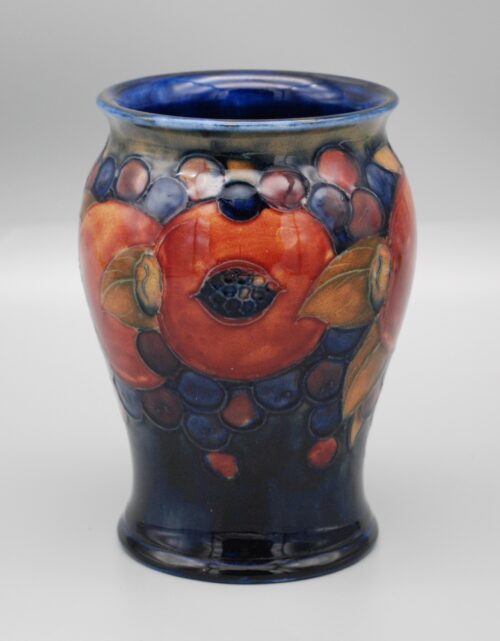
William Moorcroft Pomegranate Vase (Circa mid-1920s)
Presenting a fine William Moorcroft vase in the highly sought-after Pomegranate pattern, dating to the mid-1920s. Measuring 13cm in height and 9.5cm in width, the vessel features a well-proportioned baluster form with a gently flared rim and a sweeping circular foot. The piece survives in excellent original condition, completely free from chips, cracks, or restoration.
The tube-lined decoration displays the iconic Pomegranate design, featuring a continuous frieze of both whole and open fruit revealing intricately detailed seeds. These are interspersed with lush clusters of rounded berries and trailing autumnal foliage. The vibrant ochre, russet, and deep crimson tones of the pomegranates contrast strikingly against the characteristic inky cobalt blue ground, which transitions subtly to a mottled greenish-ochre toward the upper rim. The high-gloss glaze remains rich and reflective, enhancing the depth of the metallic oxide colors.
The underside displays the impressed factory marks "MOORCROFT" and "MADE IN ENGLAND", alongside William Moorcroft's painted "WM" flash monogram in blue, confirming its authentic mid-1920s production period.
-
-22%

 Double Ribbed Martin Brothers Lustre vase - June 1907 For sale is this really interesting example of Edwin and Walter Martins' organic pottery work. The vase is of subtle bulbous form, with a multitude of thin horizontal ribs and then large pronouced vertical ribs from the waist to the top rim. The Brothers have then applied a rich deep brown / dark grey / black colour with metallic oxide to give a wonderful lustre to the piece. In the photographs, observe the different angles where we try and illustrate the effect. This is a wonderful example of their work and is a most subtle, yet highly competent execution. Condition and Provenance The vase is in excellent original condition, with no chips, cracks, or repairs. A couple of specks on the main body of the vase are small imperfections during the manufacture of the vase. The signature beneath is 100% consistent with period pieces and is marked "6-1907, Martin Bros, London & Southall", again entirely consistent and authentic. See the V&A Museum picture below of a virtually identical example from the same year by Edwin.
Shop
Your account
Subscribe to our newsletter.

© Copyright 2026 GT Art Pottery