Martin Brothers Gnarly Olive Jug
Martin Brothers Gnarly Olive Jug
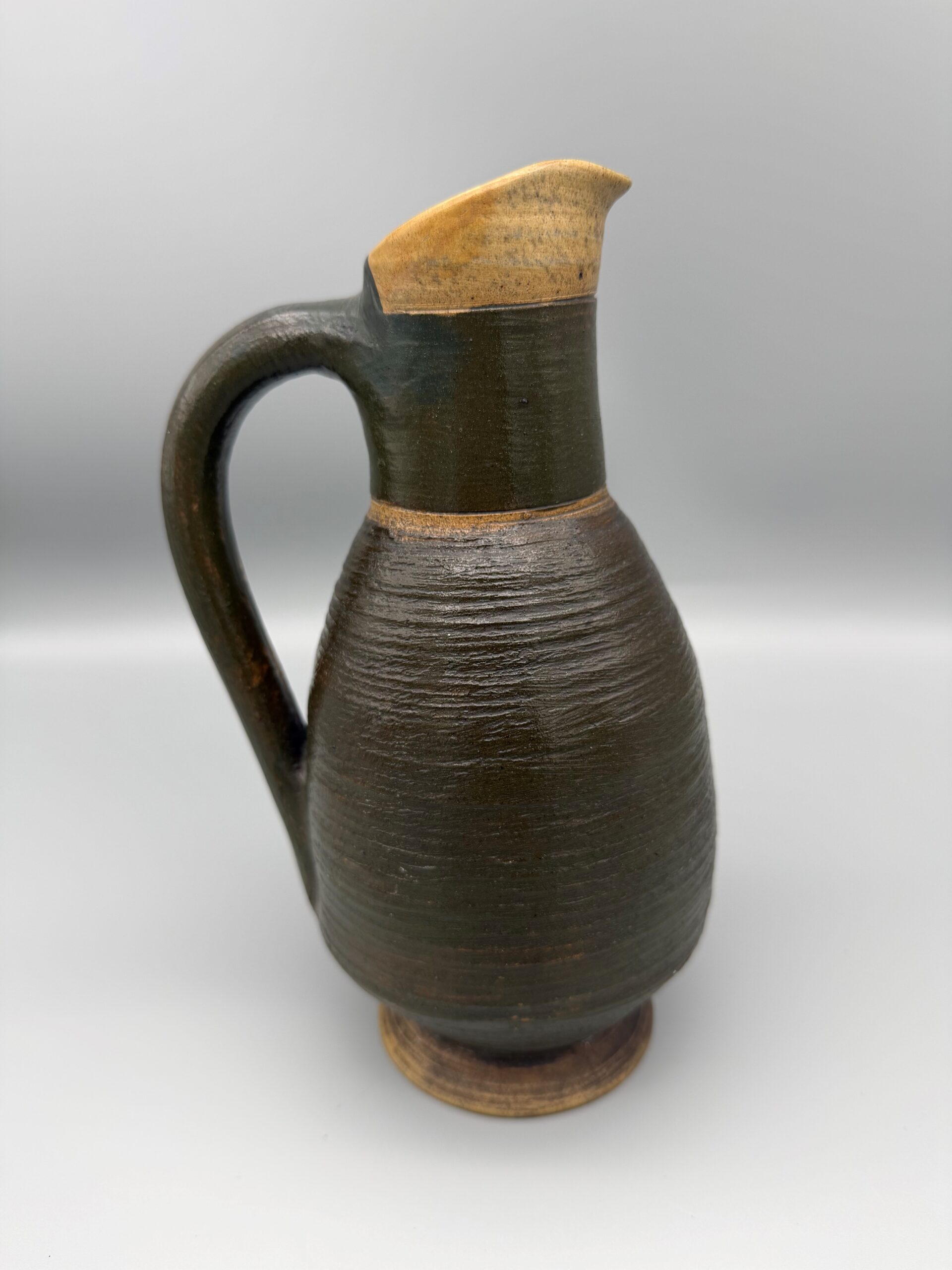
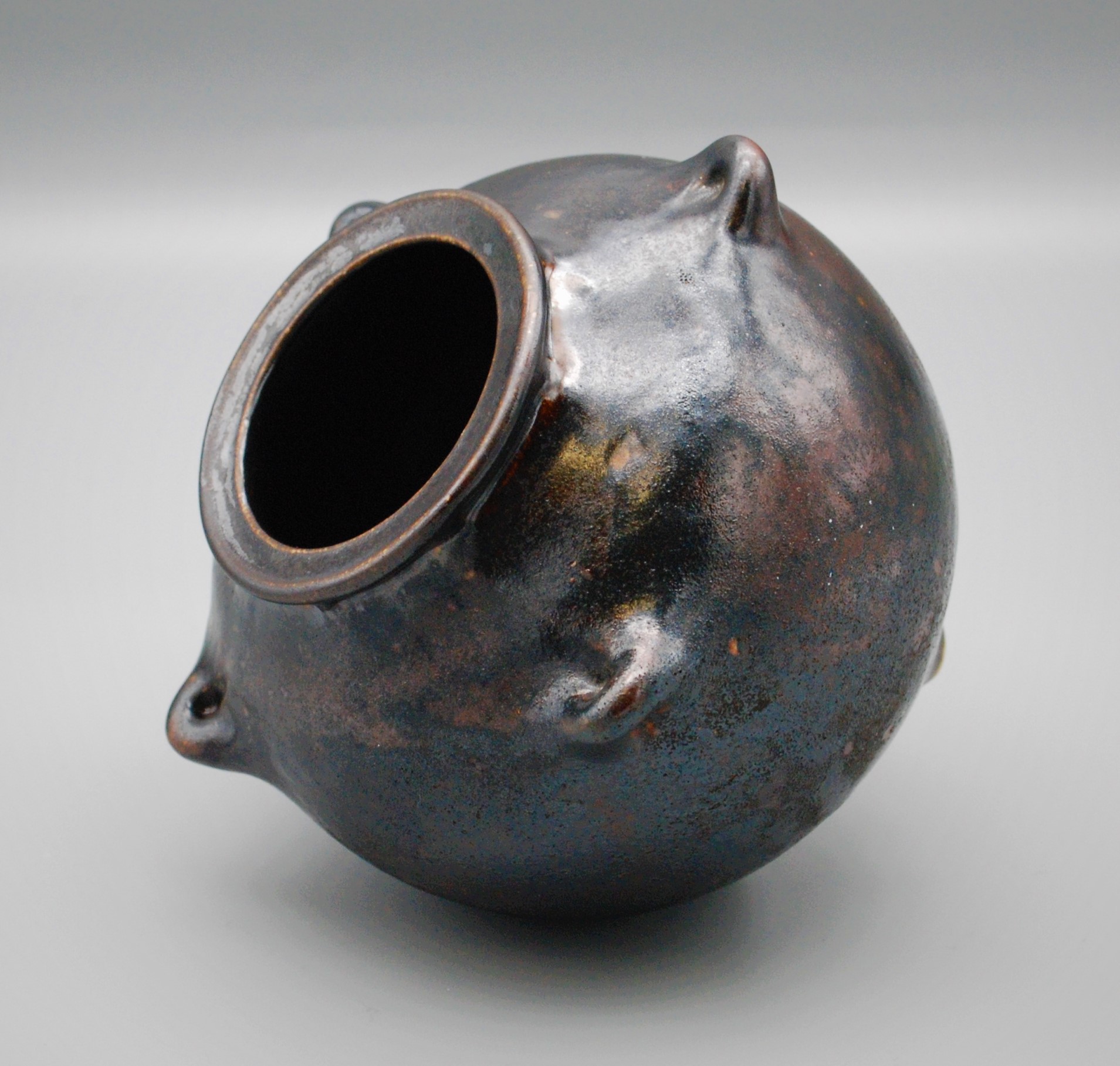
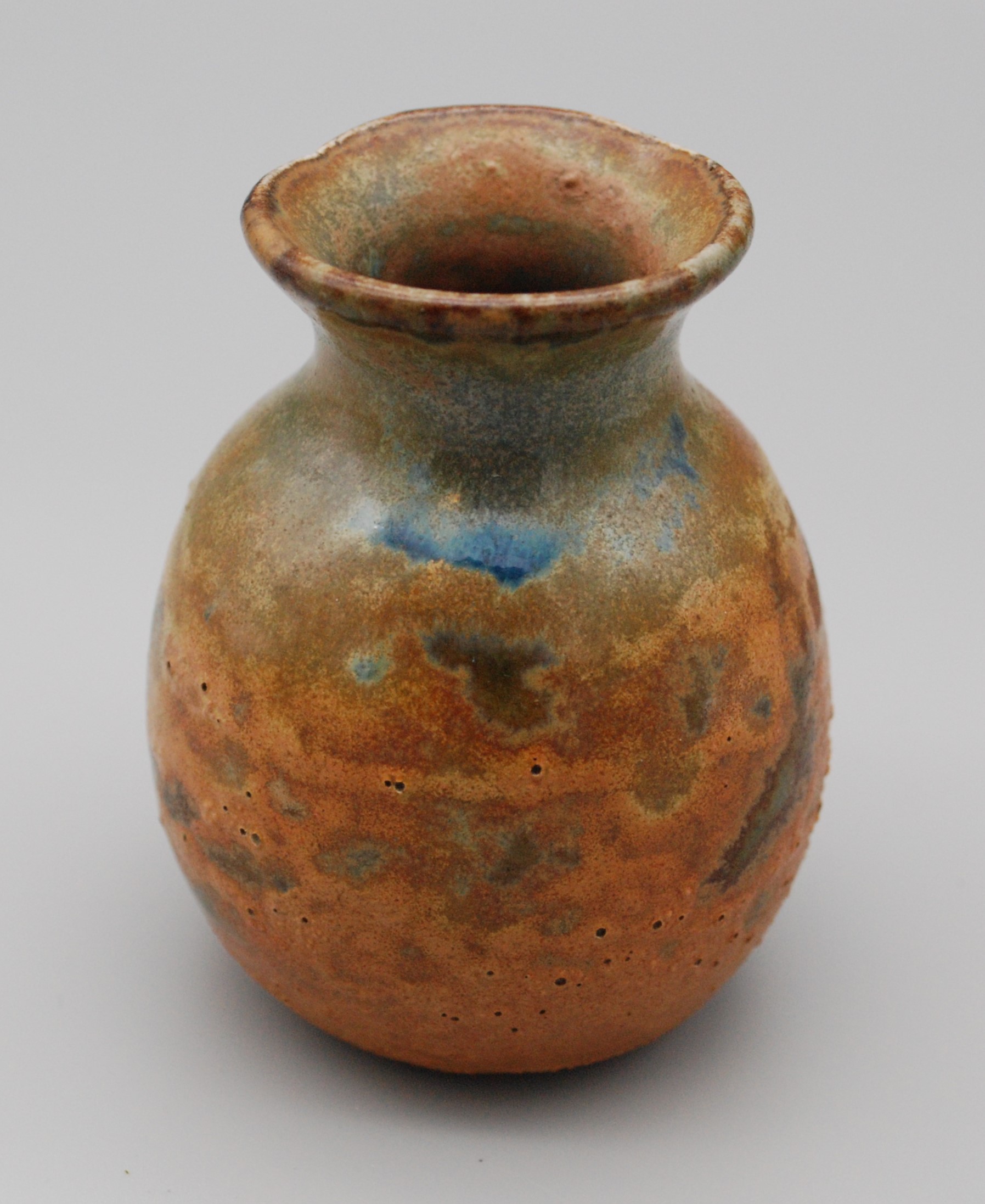
Presenting an exceptional, historic gnarly-designed Martin Brothers art pottery jug, measuring approx. 22.5cm in height and 12.5cm in diameter. This piece from a highly sought-after potter features a robust baluster form jug, resting securely on a flared circular foot. Its gnarly silhouette is defined by a bulbous lower body that tapers into a cylindrical neck, culminating in a sweeping pouring lip and an applied, sturdy strap handle.
The jug is characterized by its tactile, heavily ribbed texture, a testament to its hand-thrown origins by eccentric brothers. A rich, dark olive-brown salt glaze dominates the meticulously textured body and handle. This deep, lustrous finish contrasts strikingly against the lighter, biscuit-toned clay left exposed at the rim, the interior, a thin defining band at the shoulder, and the foot. This earthy, two-tone palette masterfully accentuates the horizontal throwing lines that encircle the entire vessel.
Beneath the foot, the unglazed natural clay base proudly bears the authentic, hand-incised cursive signature reading “Martin” and “London”, securing its prestigious provenance. Preserved impeccably, this remarkable piece presents in excellent, original, and entirely undamaged condition, making it a museum-quality acquisition for discerning collectors of late 19th and early 20th-century British studio pottery.
Doulton Lambeth Arthur Barlow Jug
Early Doulton Lambeth Stoneware Jug by Arthur Barlow, dated 1874, with Silver Mounts and Hinged Lid
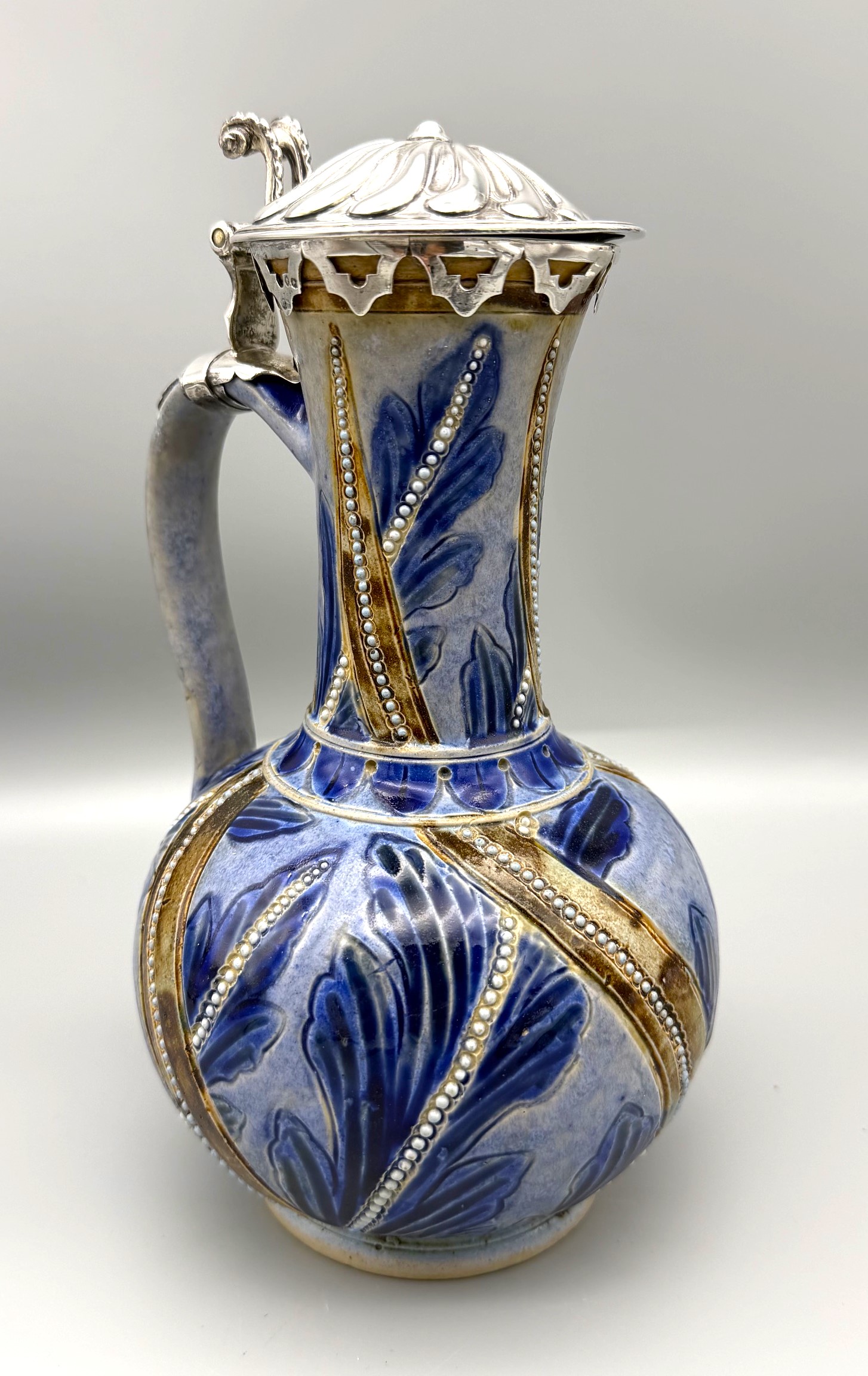
This exceptional jug, produced in 1874, is a particularly fine example of Arthur Barlow’s mature decorative style. The elegant ovoid body rises to a tall, tapering neck and is fitted with an ornate silver-mounted hinged cover, its repoussé decoration complementing the flowing organic forms of the pottery beneath. The substantial swept handle provides a graceful counterbalance to the elongated neck while lending the piece a refined architectural silhouette.
Provenance & Condition
The underside retains its full complement of factory marks, including the impressed Doulton Lambeth oval stamp with the date 1874, Arthur Barlow’s impressed “ABB” artist’s initials, together with the relevant assistant decorators’ marks, firmly authenticating its early production and studio attribution.
The jug is presented in excellent overall condition, displaying no significant issues to the stoneware body or decoration. The silver-mounted hinged cover is secure, and it is noted that adhesive has been used at some point in the past to reinforce the fitting of the silver lid to the ceramic top rim. This is a minor historic restoration that does not detract from the piece’s outstanding decorative appearance or its importance as an early, fully documented work by one of Doulton Lambeth’s most celebrated artists.
William Moorcroft Pomegranate Vase
William Moorcroft Pomegranate Vase (Circa mid-1920s)
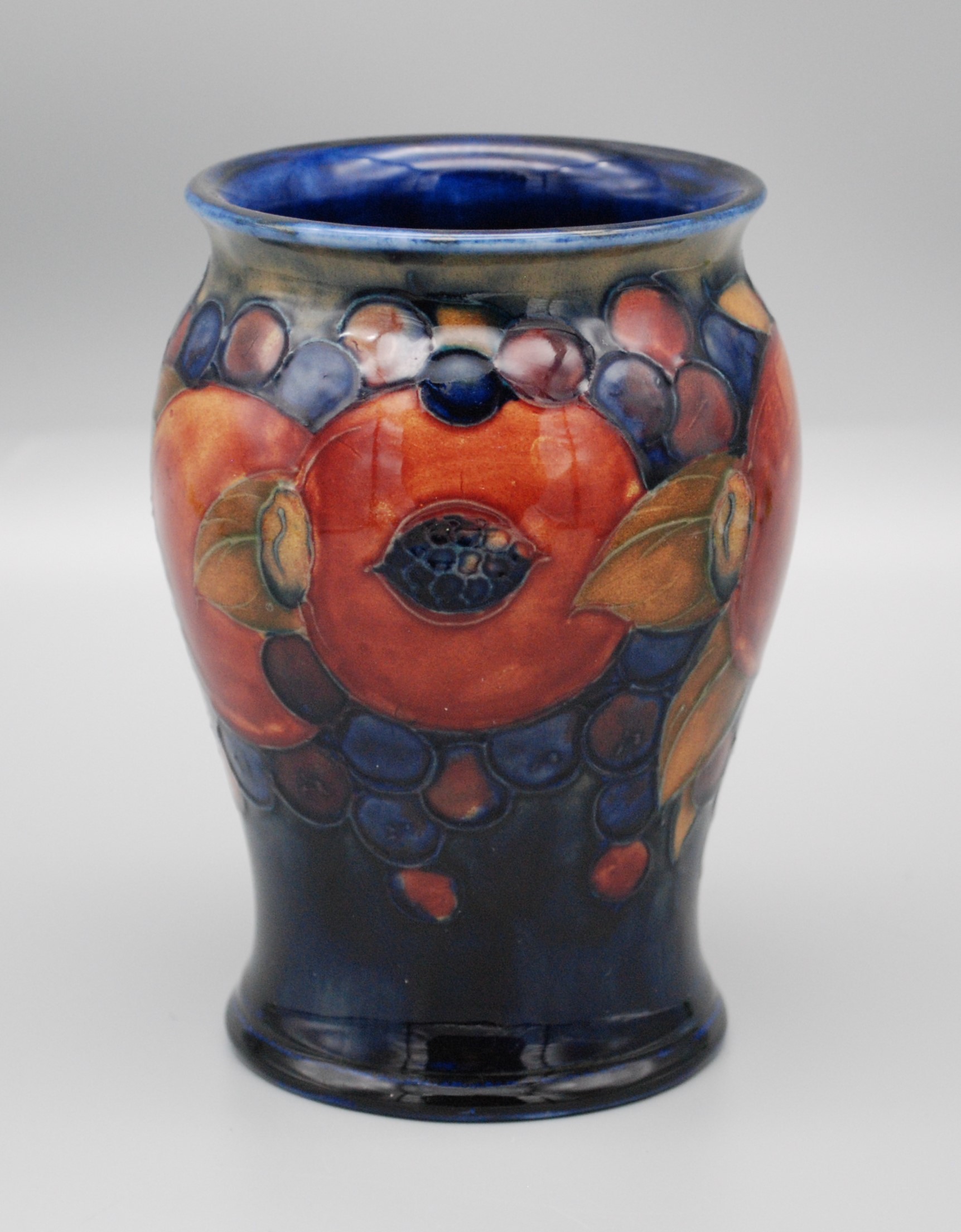
Presenting a fine William Moorcroft vase in the highly sought-after Pomegranate pattern, dating to the mid-1920s. Measuring 13cm in height and 9.5cm in width, the vessel features a well-proportioned baluster form with a gently flared rim and a sweeping circular foot. The piece survives in excellent original condition, completely free from chips, cracks, or restoration.
The tube-lined decoration displays the iconic Pomegranate design, featuring a continuous frieze of both whole and open fruit revealing intricately detailed seeds. These are interspersed with lush clusters of rounded berries and trailing autumnal foliage. The vibrant ochre, russet, and deep crimson tones of the pomegranates contrast strikingly against the characteristic inky cobalt blue ground, which transitions subtly to a mottled greenish-ochre toward the upper rim. The high-gloss glaze remains rich and reflective, enhancing the depth of the metallic oxide colors.
The underside displays the impressed factory marks “MOORCROFT” and “MADE IN ENGLAND”, alongside William Moorcroft’s painted “WM” flash monogram in blue, confirming its authentic mid-1920s production period.
Martin Brothers Miniature Blue Vase
Martin Brothers Gnarly Olive Jug
Presenting an exceptional, historic gnarly-designed Martin Brothers art pottery jug, measuring approx. 22.5cm in height and 12.5cm in diameter. This piece from a highly sought-after potter features a robust baluster form jug, resting securely on a flared circular foot. Its gnarly silhouette is defined by a bulbous lower body that tapers into a cylindrical neck, culminating in a sweeping pouring lip and an applied, sturdy strap handle.
The jug is characterized by its tactile, heavily ribbed texture, a testament to its hand-thrown origins by eccentric brothers. A rich, dark olive-brown salt glaze dominates the meticulously textured body and handle. This deep, lustrous finish contrasts strikingly against the lighter, biscuit-toned clay left exposed at the rim, the interior, a thin defining band at the shoulder, and the foot. This earthy, two-tone palette masterfully accentuates the horizontal throwing lines that encircle the entire vessel.
Beneath the foot, the unglazed natural clay base proudly bears the authentic, hand-incised cursive signature reading “Martin” and “London”, securing its prestigious provenance. Preserved impeccably, this remarkable piece presents in excellent, original, and entirely undamaged condition, making it a museum-quality acquisition for discerning collectors of late 19th and early 20th-century British studio pottery.
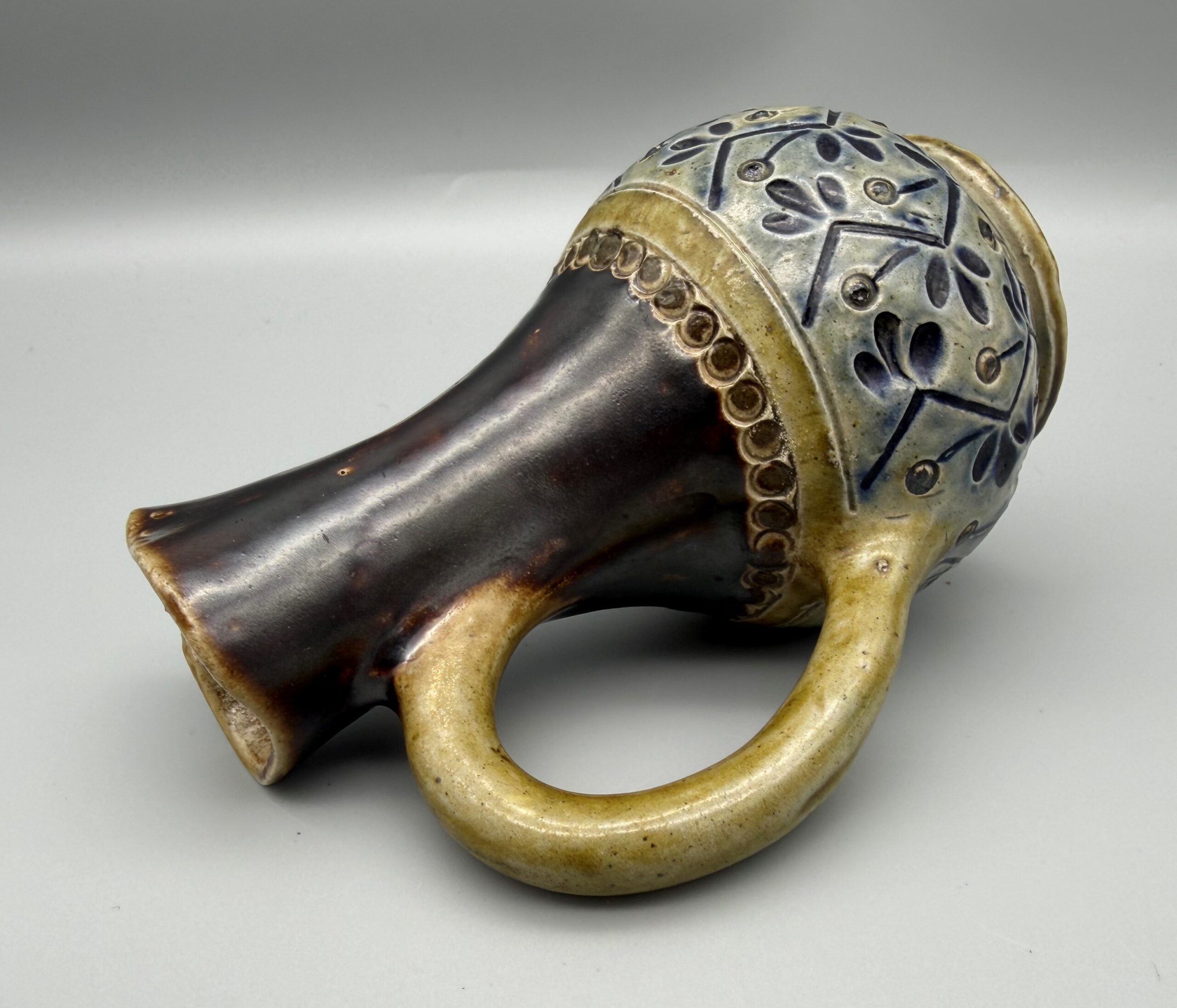
Martin Brothers Early Small Jug
Martin Brothers Early Stamped Small Jug
For sale is this truly delightful early Martin Brothers jug, dated 23-06-1880. Rare to find, this jug is stamped with the early “R.W. Martin Southall” stamp which dates it authentically to 1880.
To the top half, the jug has been coloured with a mix of rich brown and light metallic oxides to give the brown an additional sheen to it. Beneath, bandings of small circles and lines separate the brown top section from the framing of the zig-zag simple foliate and flower desgned motifs. A subtle olive-green presents in the centre bandng and onto the jug handle for further contrast to this wonderful early piece.
Beneath, the R.W. Martin Southall” stamp is clear as well as the hand-inscribed date of 23-06-1880.
This piece is in wonderful orginal condition and is free from any chips, cracks or repairs. It measures 14cm tall by approximately 10.5cm wide including the handle.
This is Martin Brothers in its simple authenticity, in wonderful condition. Adding it to your collection will not disappoint and it is a lovely size for a cabinet.
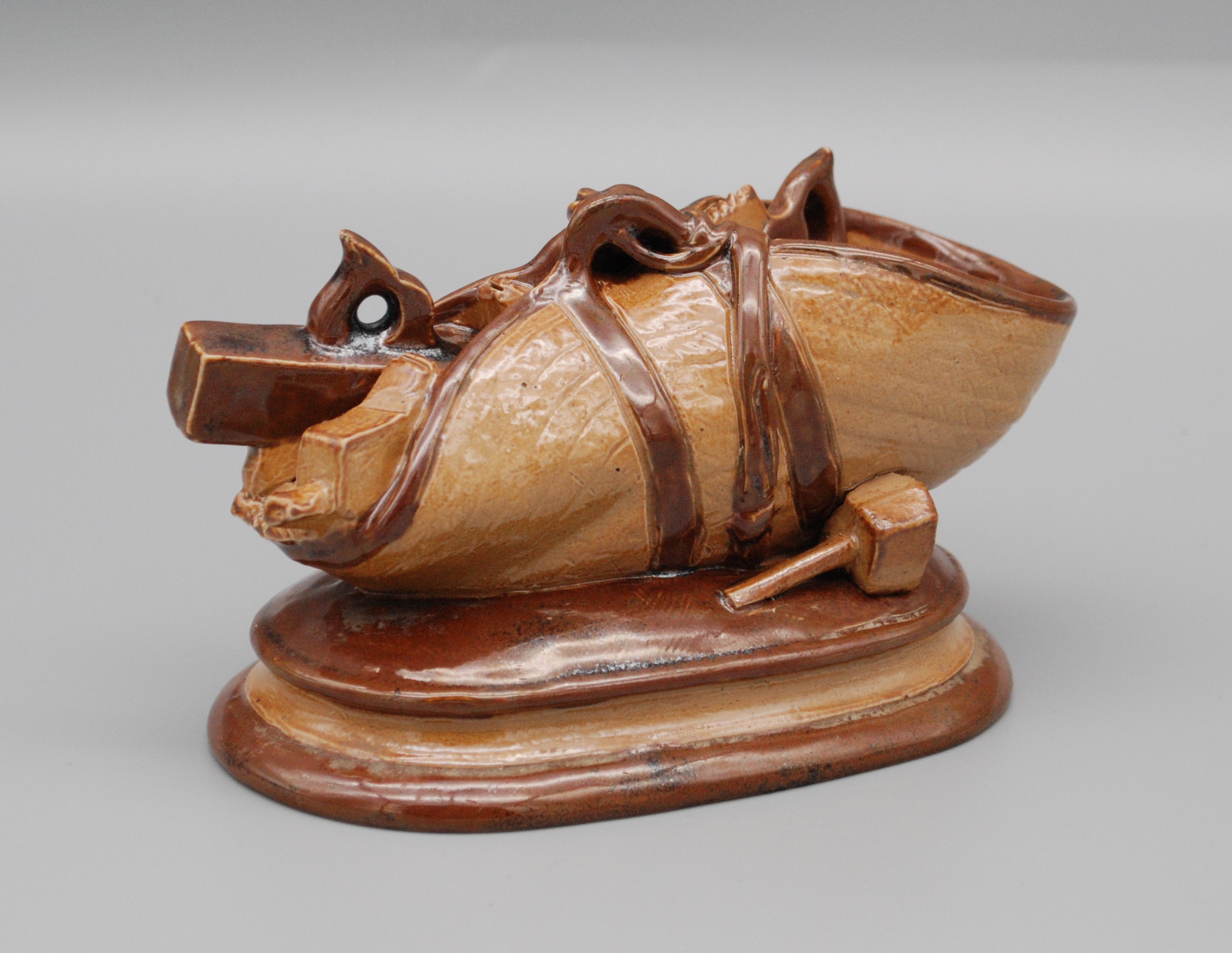
Doulton Lambeth George Tinworth Carpenters Bag
Rare George Tinworth for Doulton Lambeth – Stoneware Model of a Carpenter’s Bag (c. 1880s–1890s)
This finely modelled stoneware study of a carpenter’s bag is a superb example of the whimsical yet highly skilled designs created under the direction of George Tinworth for Doulton Lambeth in the late Victorian period. Measuring approximately 13.5cm in length and 8.5cm in height, the model is remarkable for both its craftsmanship and detail.
The body of the bag is finished in a warm creamy light brown glaze, while the edges, straps, and handles are picked out in a contrasting darker hue, emphasising the form and adding depth. One side of the bag is richly decorated with Victorian-era woodworking planes, while the opposite side, open and more restrained, reveals only a woodsaw within. On the integrated stoneware plinth, tools of the trade—a mallet to one side and a chisel or file to the other—are carefully arranged, grounding the piece in the world of the Victorian craftsman.
This model captures Tinworth’s hallmark ability to combine utility, charm, and social observation in a single work of art. Pieces such as this, with their humour and realism, were often intended as conversation pieces and today are regarded as rare and highly sought-after examples of Doulton Lambeth artistry.
The base carries the impressed Doulton Lambeth circular mark, together with the initials “EMW”—likely one of the assistants or moulders working under Tinworth’s direction—along with the registration stamp “Rd” and the series number 162583. The piece remains in excellent, unrestored condition, free from cracks or repairs.
A wonderful and rare George Tinworth study, this model exemplifies the creativity and craftsmanship of the Doulton Lambeth workshops at their height and represents a fine acquisition for the discerning collector of Victorian stoneware and Tinworth’s celebrated oeuvre.
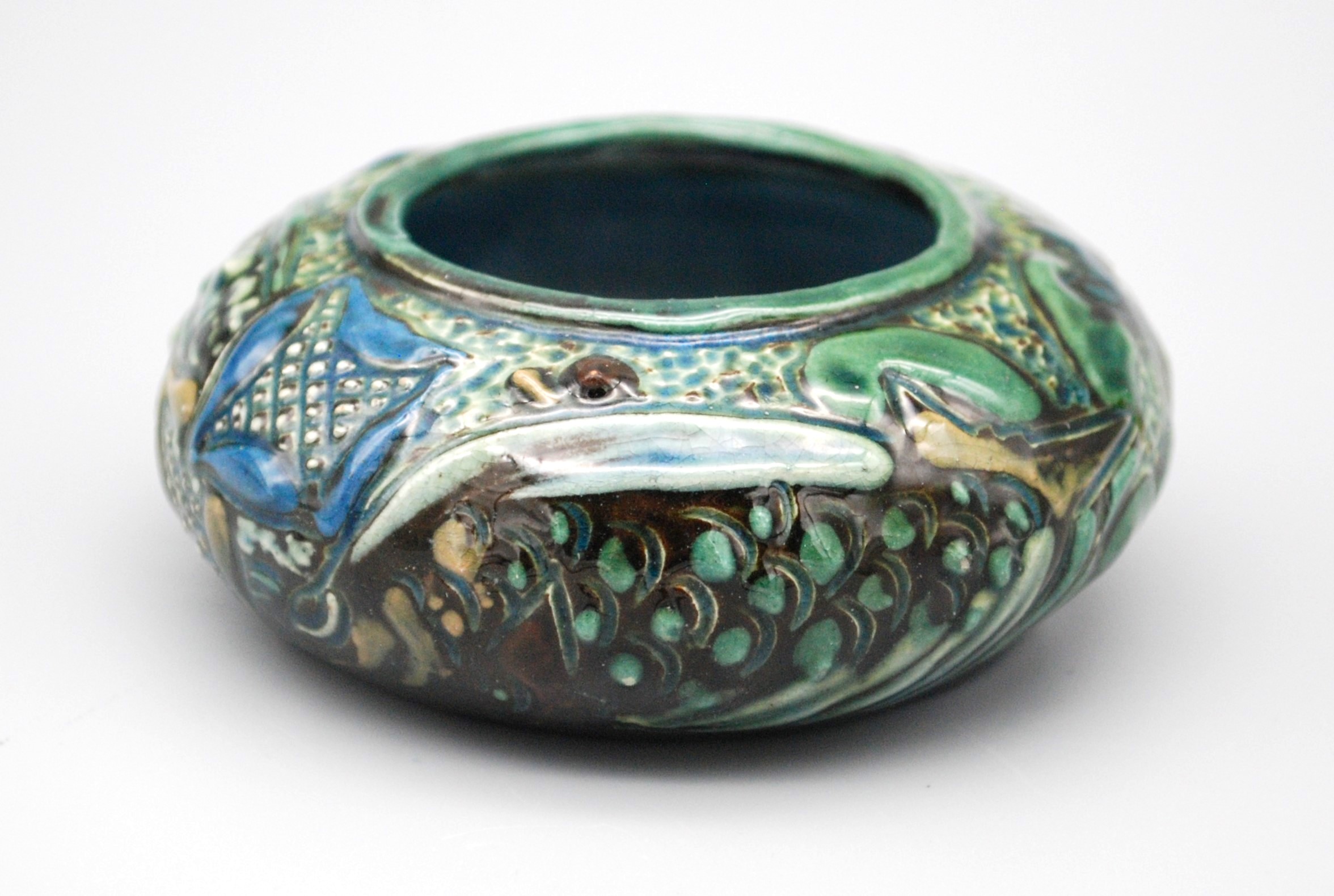
CH Brannam Green Fish Open Salt
For sale we this delightful and cute little CH Brannam “open salt” decorated with two surprisingly detailed fish dating to 1901. This is the work of Frank Thomas, one of the better known artists for the potter. The fish are surrounded by various colourful waterplants. It is a little gem of a piece.
Condition
Offered in excellent original condition with no chips, cracks or restoration.
Authenticity
For authenticity, beneath, we have the registration number of CH Brannam, “Rd 44561”, the signature CH Brannam Barum, the signature “FT” signifying the work of Frank Thomas and the date 1901.
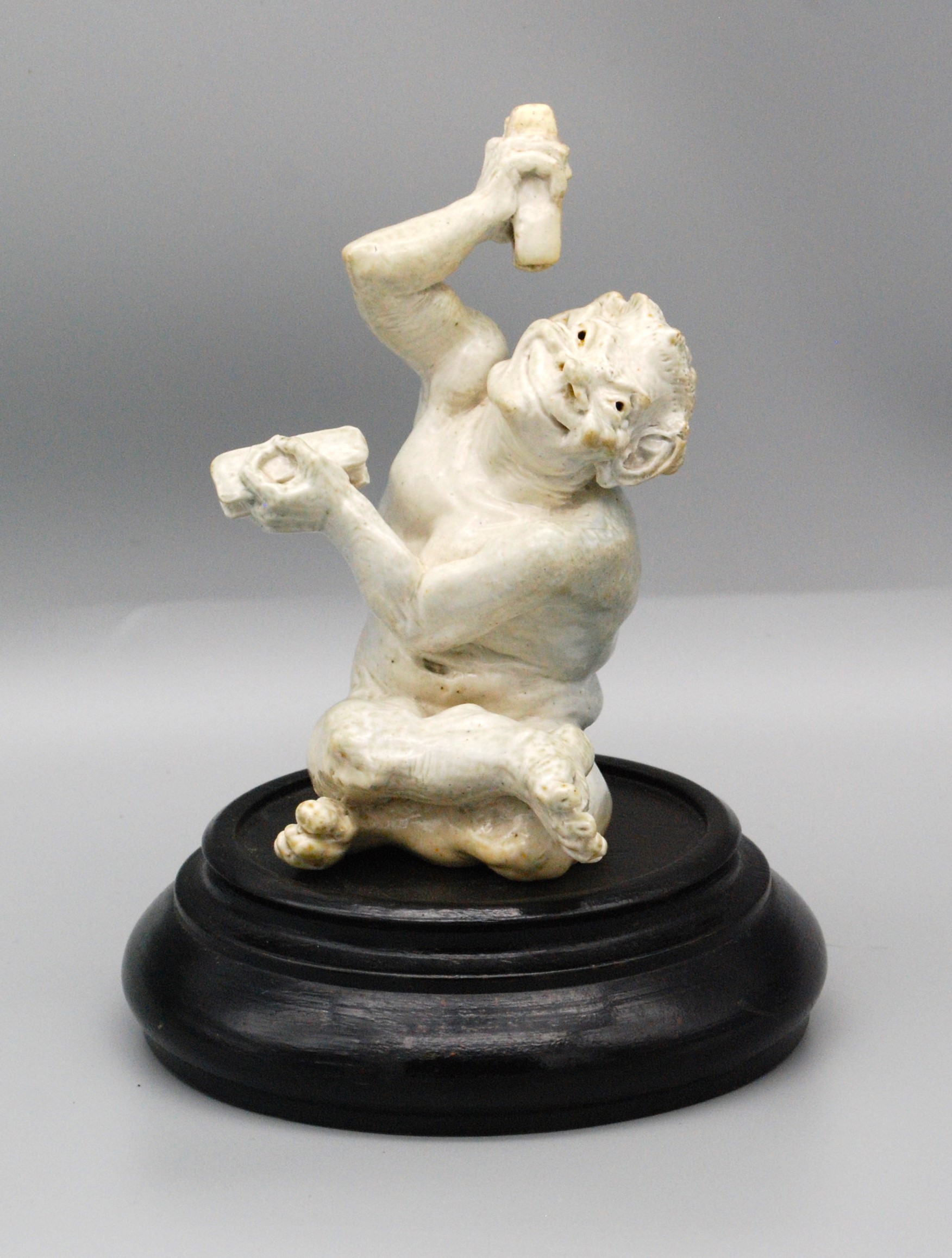
Martin Brothers Imp playing the blocks
Martin Brothers Imp playing the Blocks – Robert Wallace Martin
For sale is this delightful and cheeky looking imp playing the blocks. It is in excellent condition, with a very minor old “touch in” to the tip of the block instrument. Otherwise it is in wonderful original condition. It hails from the prominent collection of Barry Stock, a well known collector based out of the UK.
The Martin Brothers Imps are a fascinating and highly collectible series of grotesque figures, each one depicting a whimsical imp engaged in playing various musical instruments. These figures, created by the renowned Martin Brothers, are celebrated for their unique blend of humor, artistry, and intricate craftsmanship. The Martin Brothers—Robert Wallace Martin, Edwin Martin, Walter Martin, and Charles Martin—were pioneers in the field of ceramic art during the late 19th and early 20th centuries. They are best known for their imaginative and often eccentric creations, which have garnered a dedicated following among collectors and art enthusiasts.
Doulton Lambeth Emily J Edwards Ewer
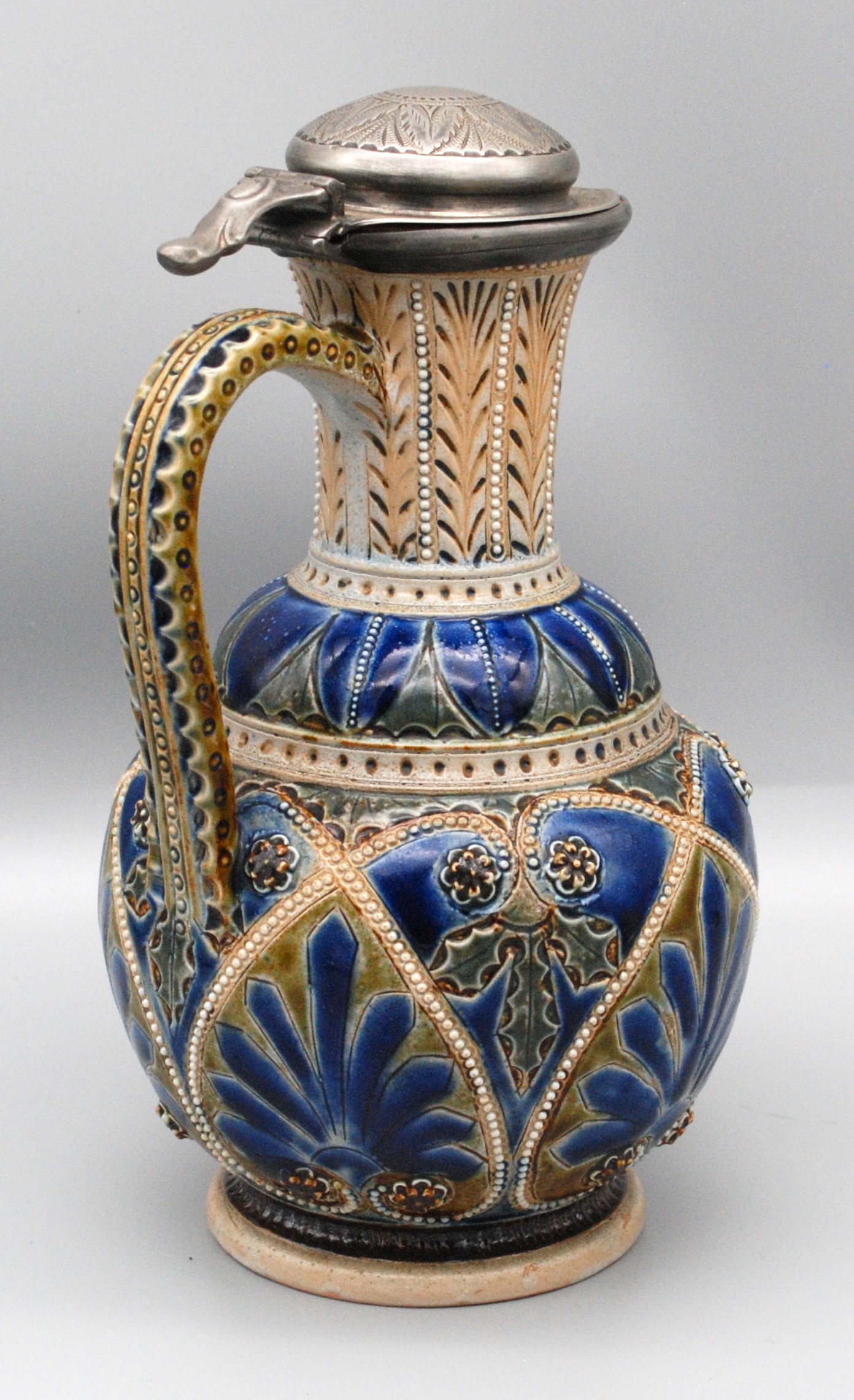
For sale we have an early beautiful Doulton Lambeth ewer by rare artist Emily J Edwards, dating to 1875. The design work shows early Tinworth influences, however Emily was a very talented artist and brings her own creativity to the piece. Holly leaves hanging from beaded banding, and then a mix of florals and angular motifs to make this an impressive piece. The dotted collars at the base of the neck show influences from Arthur Barlow too, Adorned with a pewter lid, this piece is as authentic and original as they come. A lovely piece for a rare artist who is much rarer to find than other artists due to her short tenure.
The jug is free from any chips, cracks or restoration. The pewter rim is original. Beneath we have Emily’s signature, together with the marks of the assistant and thrower and the Doulton Lambeth oval stamp with the date 1875.
Doulton Lambeth Elizabeth Fisher Bowl
£245.00
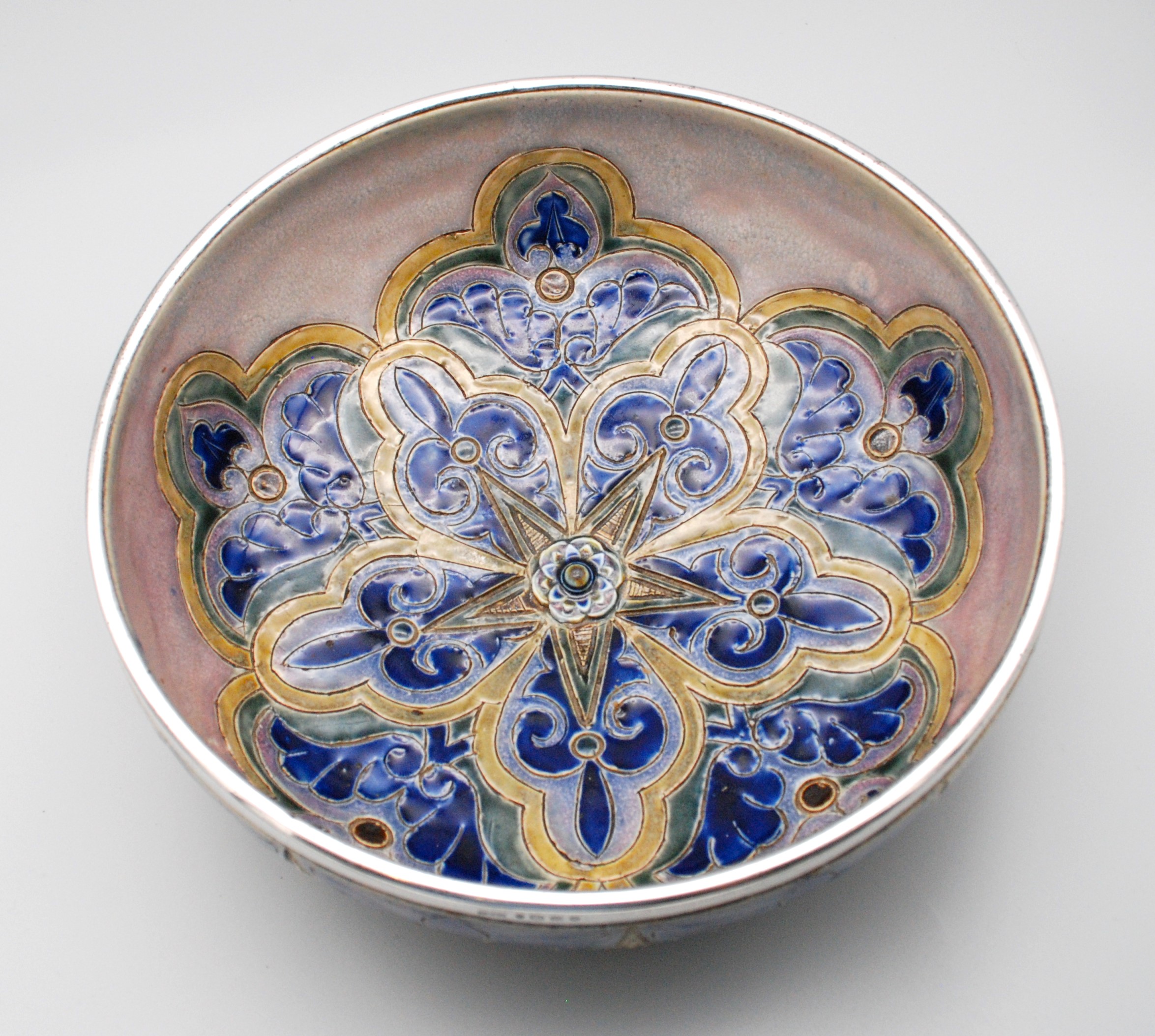
For sale we have a stunning, large Doulton Lambeth bowl by artist Elizabeth Fisher, dating to 1882. The colours and designs both inside and out on this bowl are of the first order, with geometric shapes integrated into softer rounded shapes. The collour way is exquisite – we have rich blues in the centre of the designs, followed by light blue, yellow and then purple and pink to create a most striking bowl. The edge is rimmed with solid silver, made in Birmingham and is original to manufacture.
The Bowl is free from any chips, cracks or restoration. The silver rim is original. Beneath we have Eliza Fisher’s signature, together with the marks of the assistant and thrower, a code “327” and the Doulton Lambeth cog stamp with the date 1882.
William Moorcroft Eventide Squat Vase
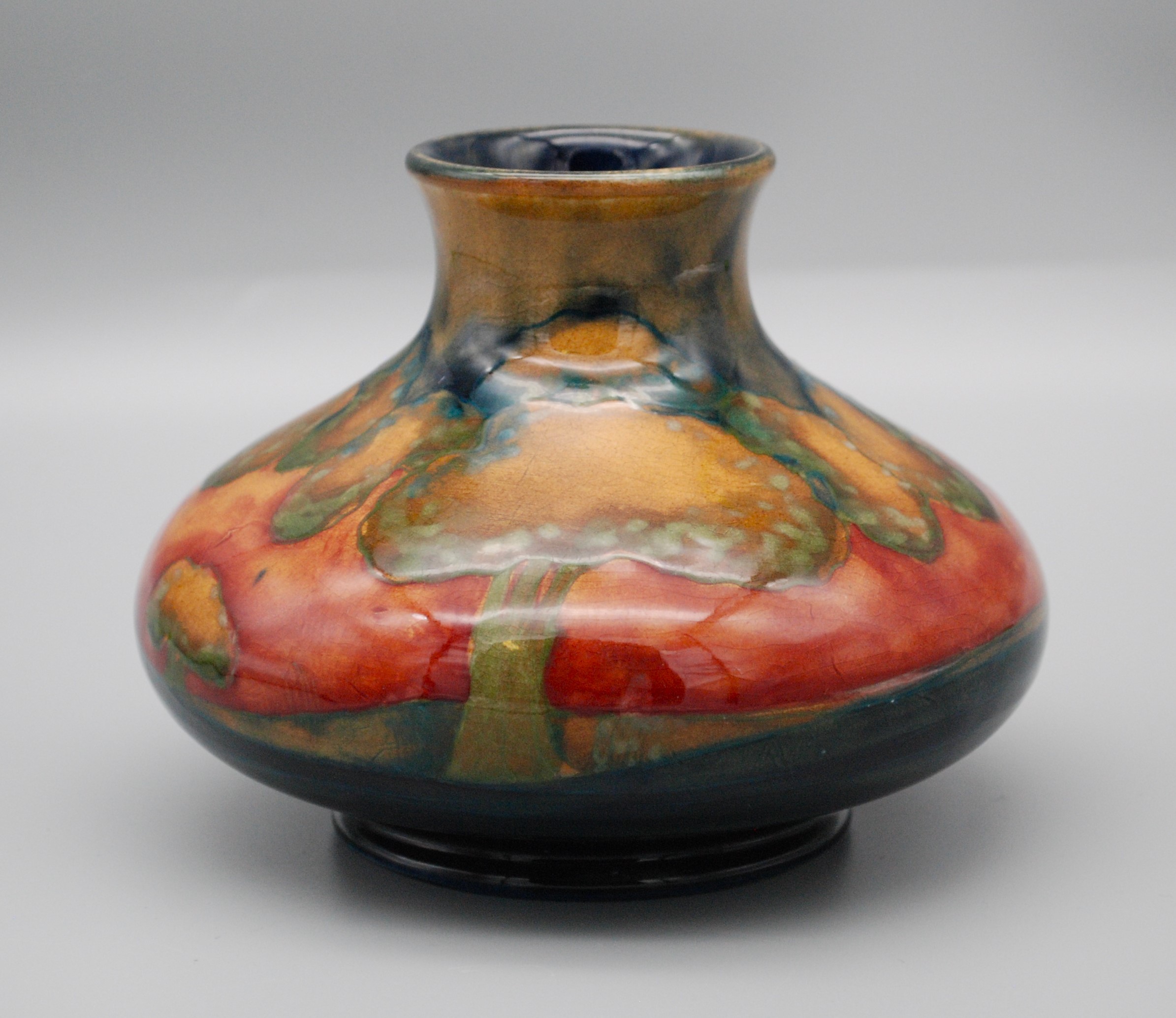
For sale is this gorgeous, Eventide squat vase by William Moorcroft, dating to 1928 or soon thereafter. Decorated with large and small trees in the wondrous evening red/amber colourway, it is a wonderful vase that displays extremely well due to the angles of the vase under cabinet lights! The Eventide pattern prominently features a landscape scene, typically showcasing a moody, twilight setting and is characterized by its depiction of trees and often includes a setting or rising sun, casting a warm, glowing effect over the scene. It is one of the most sought after rare designs.
Doulton Lambeth Hannah Barlow Miniature Horses Vase
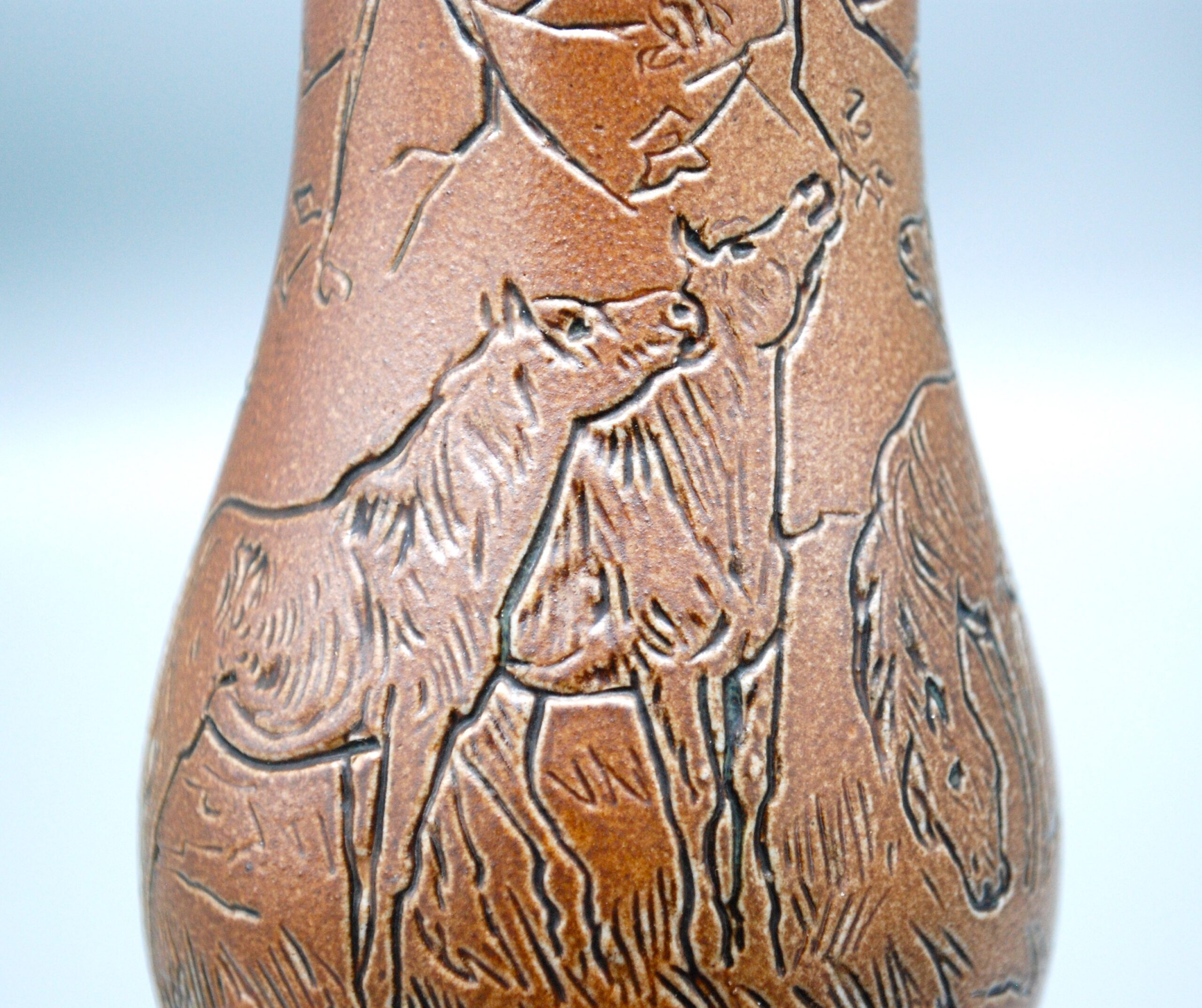
For sale we have a gorgeous Doulton Lambeth miniature Hannah Barlow vase, dating to the turn of the century.
Decorated with five horses eating grass and nibbling tree leaves, this diminutive vase is a true delight. With a bronzed stoneware glaze on which Hannah has worked her sgraffito, it is a warm, charming little piece. It would not surprise if a hint of metallic oxides were used as there is a slight lustrousness to the glaze. Measuring 13cm, or just over 5 inches, there are not many Hannah Barlow pieces of this size around!
Doulton Lambeth Hannah Barlow Horses Jug
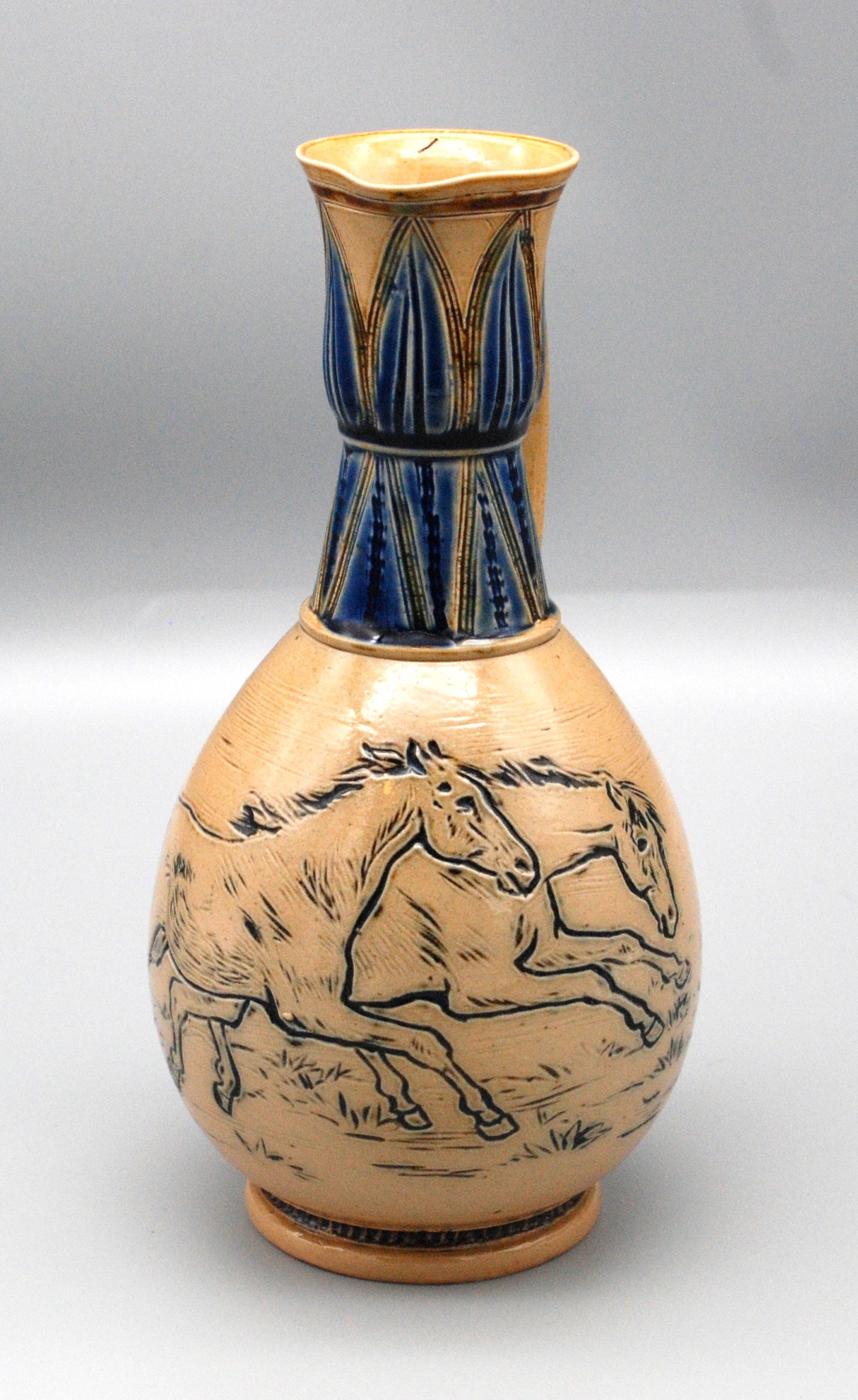
For sale is a delightful and very early Hannah Barlow Horses jug, dated 1874. Presented with two horses galloping to the front of the jug, wild grasses adorn the rear of the jug. Blue foliate designs dominate the neck up to the top rim and are typical of these early, simpler designs that are more understated than flamboyant. The handle is similarly decorated in repeated blue foliates from bottom to top.
In excellent condition, the piece is highly original, with only a small flake invisibly corrected to the rim. Everything else is correct and original as the day it left the factory. Stamped with the early oval Doulton Lambeth mark and dated 1874. Hannah Barlow’s initials are clear beneath as well as a production code.
This is a superb piece of Doulton Lambeth history which displays superbly and has a wonderful glaze to it. Should you be interested, you will not be disappointed adding it to your collection!
Doulton Lambeth Arthur Barlow FA Cup Pitcher
For sale is a very early Doulton Lambeth pitcher by Arthur Barlow with a unique story. This pitcher belonged to one of the players responsible for the very first inaugural FA Cup win in 1872. William Crake (aka William Parry), playing for Wanderers FC in 1872, claimed a 1-0 victory at Kennington Oval over a tough game with the Royal Engineers.
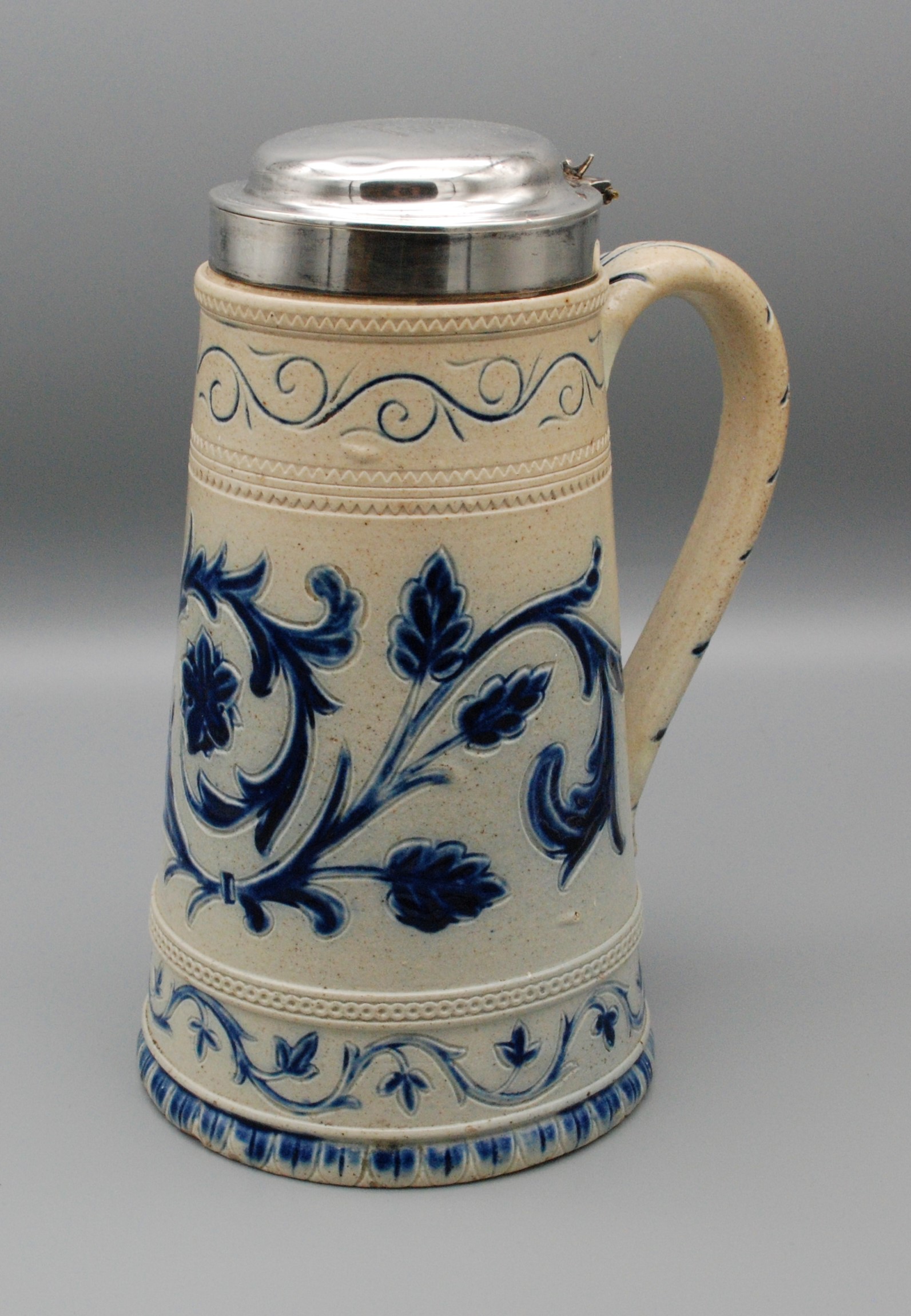
The pitcher itself is a highly desirable piece in the typical early style and colours of Doulton and Barlow. With the main body decorated with bold blue scrolling florals, there are miniature scrolling floral borders above and below. Further tactile anglular pattern borders sit below the lid, between the scroll work and to the base. The handle is decorated with a simple leaf venation pattern. The top is adorned with the original solid silver rim and lid. To top centre is the Crake family crest, and inside the lid is a lovely crisp inscription “To William Parry Crake from E.N.C. February 11th 1873.” with decorative embellishment.
This early piece is in very good condition. Professional stabilising of the handle is evident, and there are a few minor nibbles to the base commensurate with age. Otherwise, the lid is all original and there is no evidence of any other chips or cracks. The base is stamped with the early oval Doulton Lambeth mark and Arthur Barlow’s “ABB” signature is present and correct.
Doulton Lambeth Faience Floral Vase
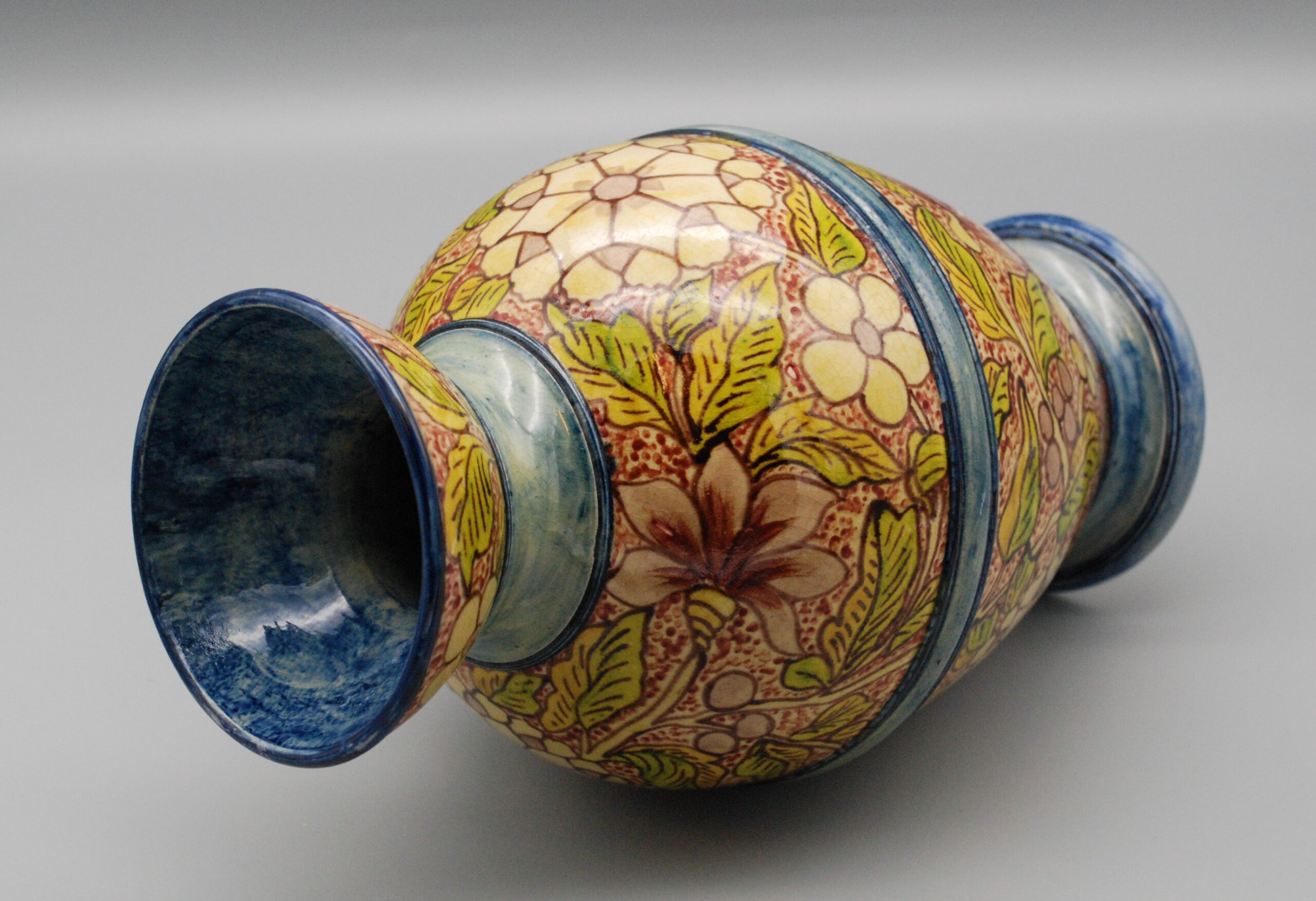
For sale is wonderful early piece of Doulton Lambeth Faience, dated 1875. Decorated by artist Mary Capes, it is what I consider a really bright and joyful piece to behond. Mary has been flamboyant, bringing pink/red hibiscus type florals and smaller yellow flowers into an intricate foliage. Interspersed, are angular, almost kaleidoscope shapes which add real interest to the aesthetic. Borders on the neck narrow, mid-body and foot use different blues to create a wonderful contrast and they keep the piece light and perfect to lift a room.
Standing 23cm tall, and 13cm wide, this is a perfect size for the collector, being flexible and presentable in or out of a lit cabinet.
Beneath are the early oval Doulton Lambeth stamps, 1875, and the painted on initials for Mary Capes. All presents correctly.
William Moorcroft Florian Green & Gold Vase
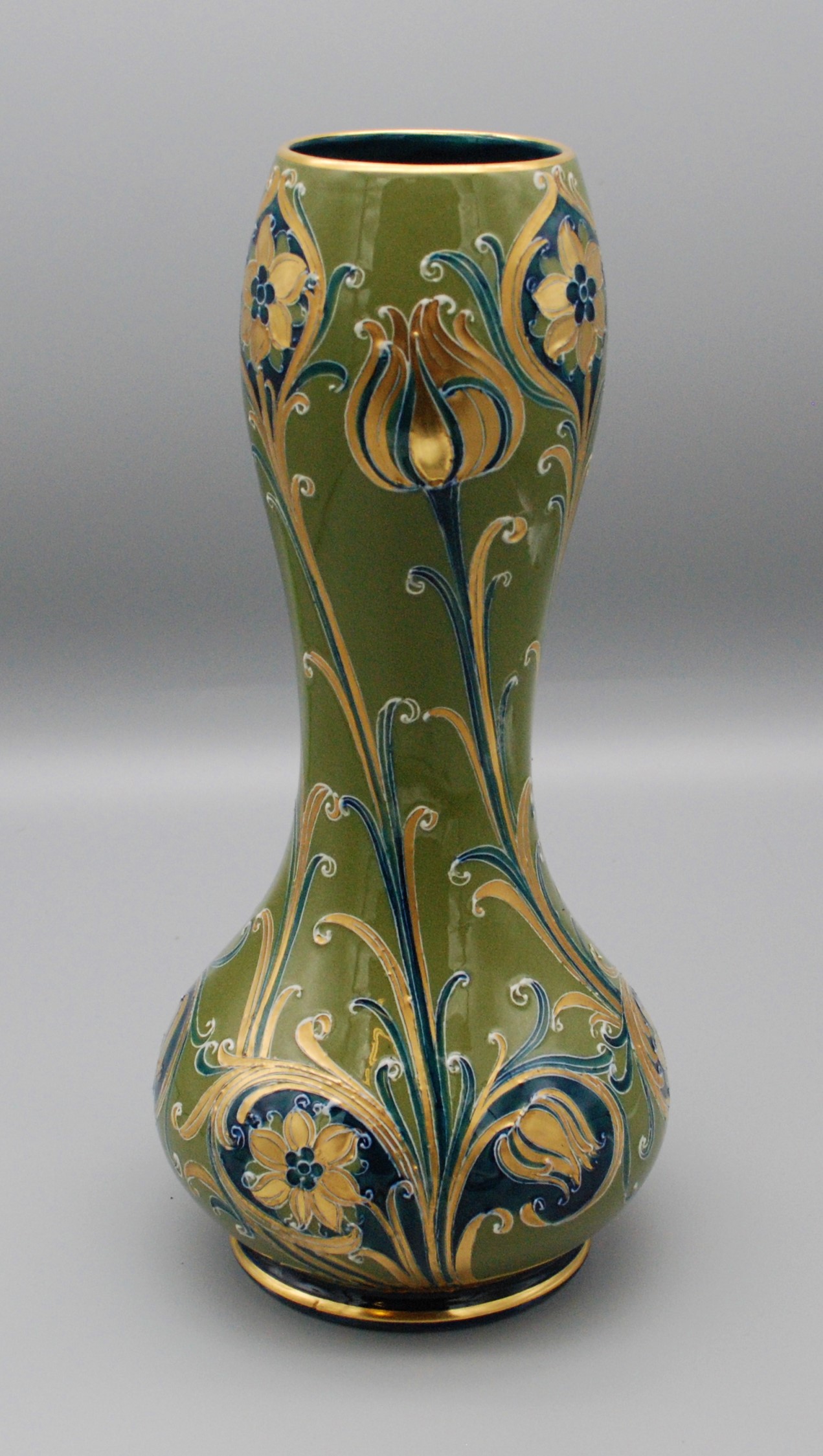
For sale is a piece of Florian “Green and Gold” by William Moorcroft circa 1903-08. In double gourd shape, it is arguably one of the most desirable shapes to secure in your collection. At 27.5cm tall, it is a substantial piece. It counts three flower and tulip buds each to the top of the vase with the same again to the bottom gourd of the vase, so twelve buds in total. The gilt is in excellent condition so this piece really “pops” in a display cabinet.
The vase is being sold in excellent original condition with no damage or restoration. Beneath, the Florian Ware stamp and William’s flash signature in green is present and correct.
Doulton Lambeth George Tinworth Beakers
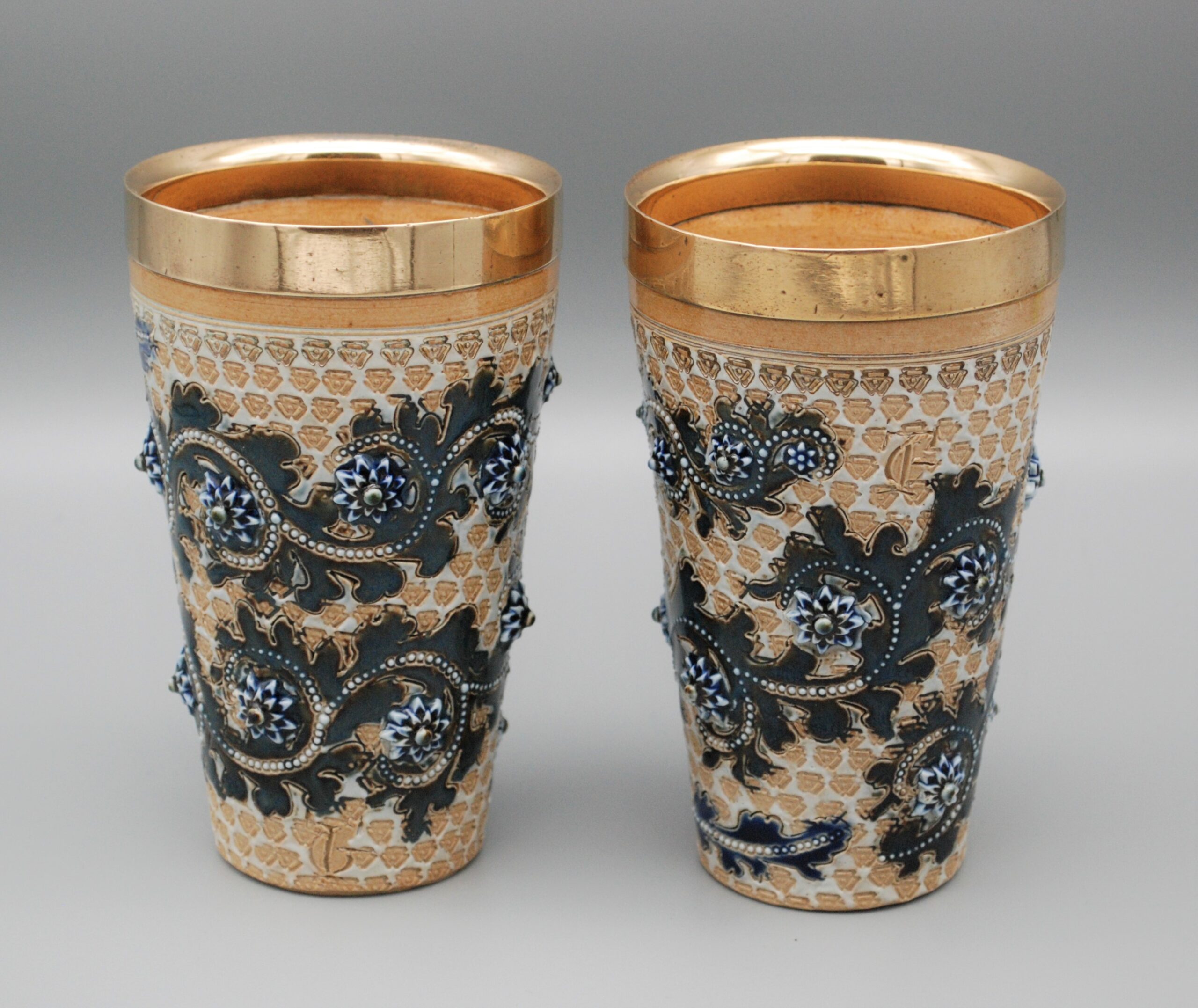
Offered for sale is a pair of wonderful lemonade beakers by renowned Doulton Lambeth artist George Tinworth. The beakers are decorated with his lovely swirling and beaded “Seaweed Scroll” design in the richest of green hues. Intermittent foliage in bold blue has been placed between, above or below the scroll work. The background is in an oatmeal colour repeatedly stamped with a small design to finish the aesthetic intensity of these art pottery pieces. Adorned to the top are excellent conditioned brass rims. In excellent original condition and fully signed, stamped and dated 1877.
Martin Brothers Miniature Cobalt Blue Vase
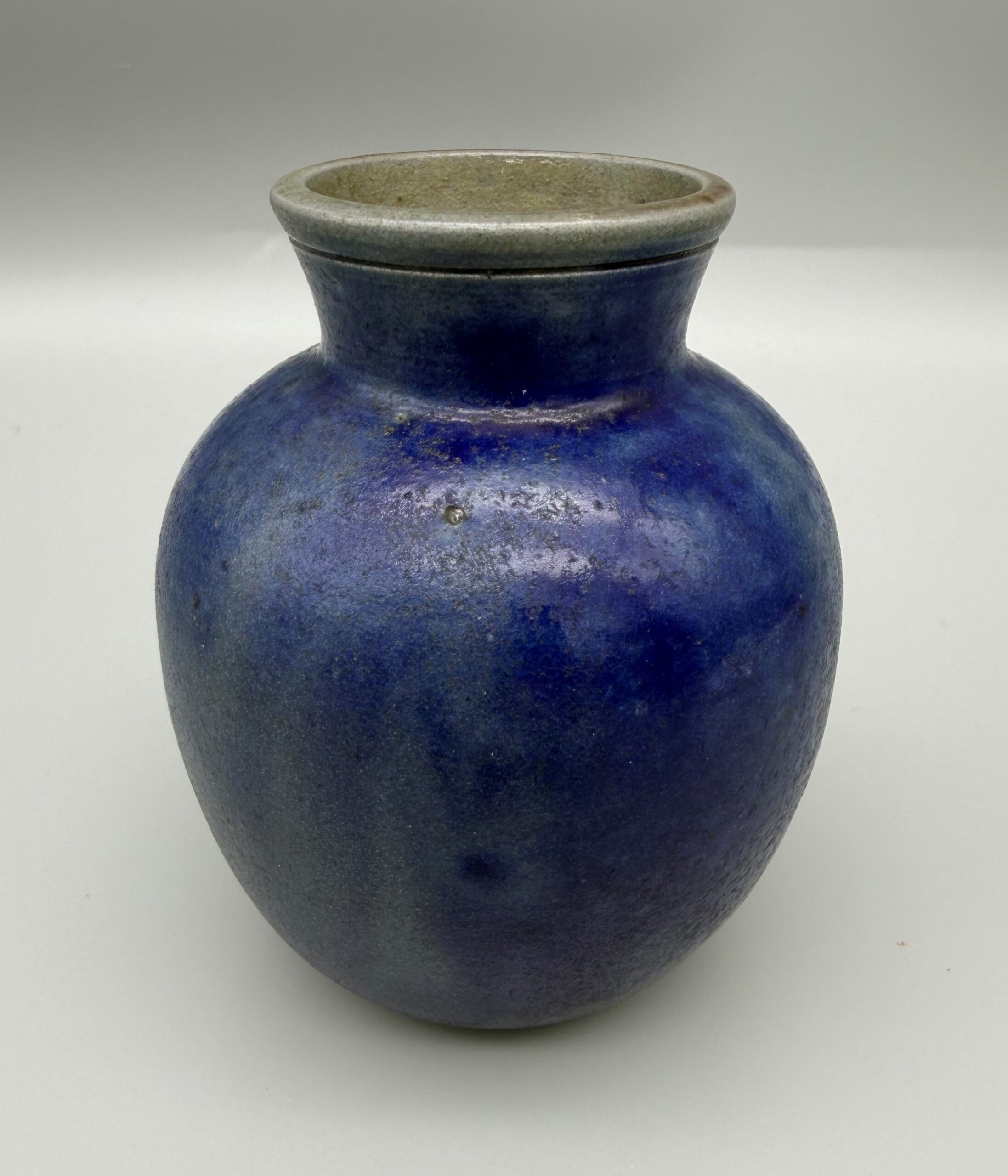
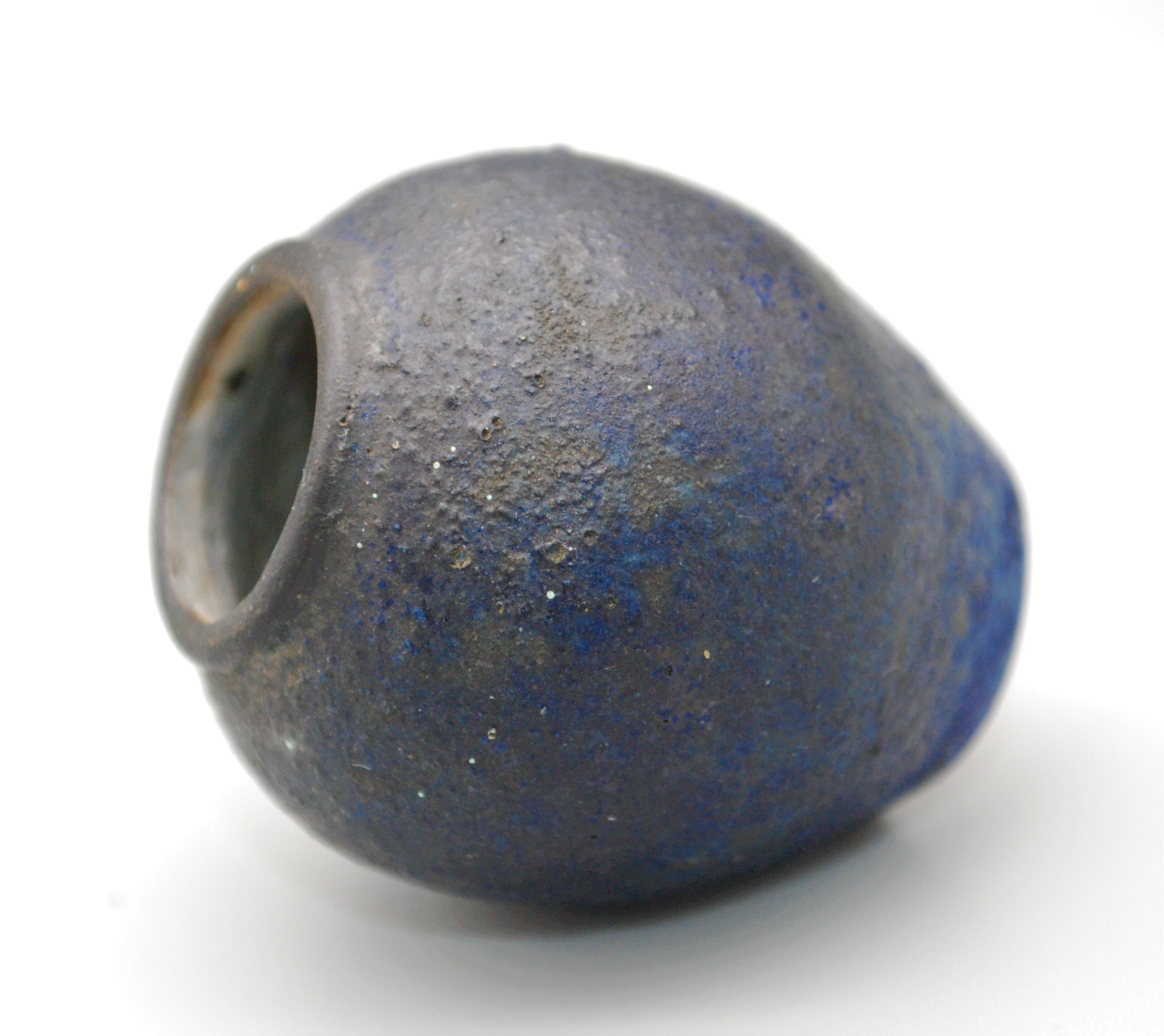
For sale is this diminutive vase, likely to have been made by Edwin Martin, the youngest of the Martin Brothers. This vase is tiny – 4cm tall by 3.75cm wide! In low light, one might mistake it as being black, but under light a strong blue shows through. With a delicate little top rim, and traditional rounded shape, it really is a vase in miniature!
Shop Grid – 3 Columnsnickgt12021-03-01T16:11:38+00:00