Martin Brothers Grotesque Reptile on Mushroom
What exactly is it?
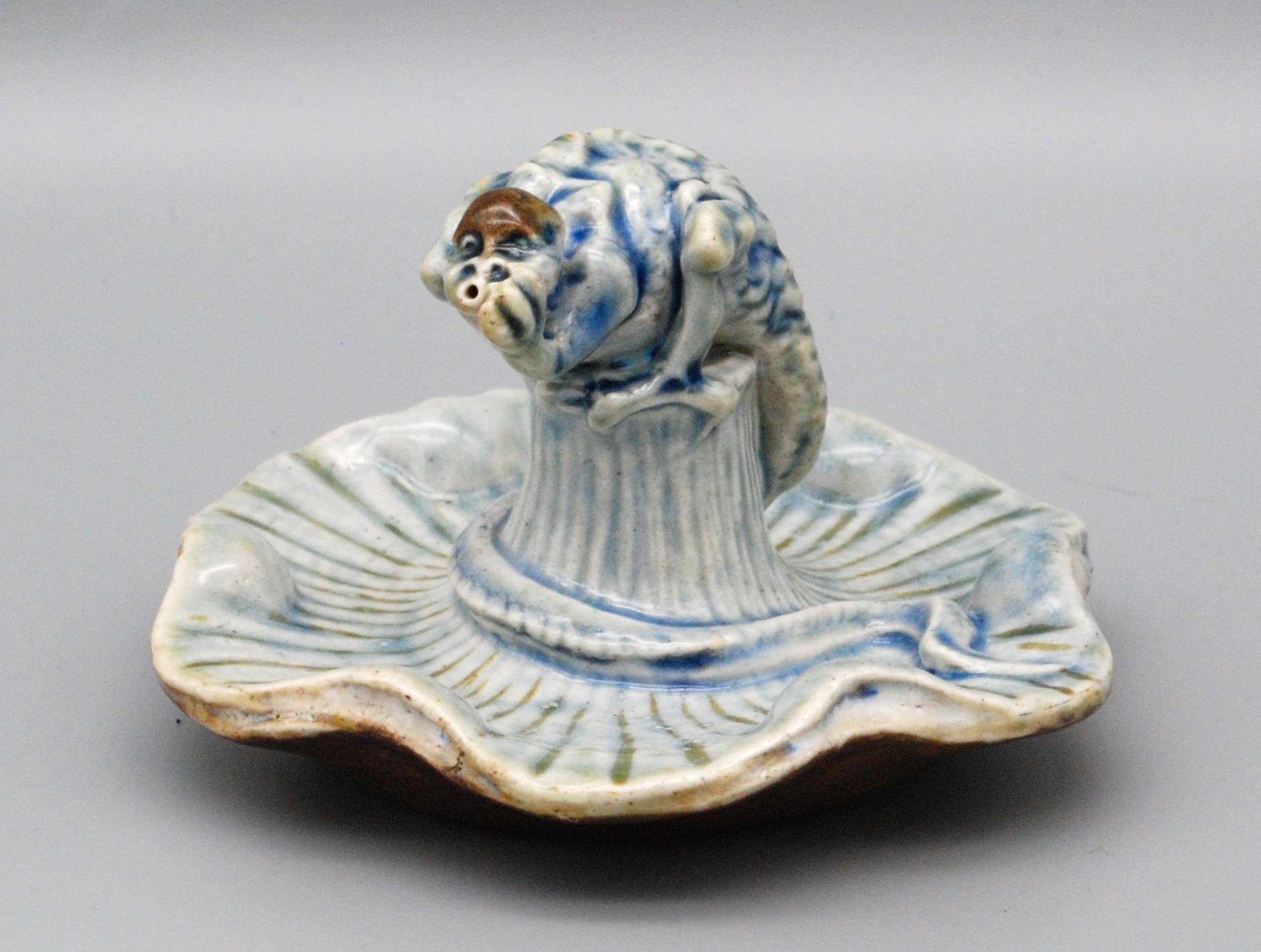
For sale is this highly unusual and grotesque Martin Brothers reptile sitting on top of an upside down mushroom. Intricately constructed with a body hideous to behold, we have not seen another quite like this piece. The creature, with almost human like face, has a hand to its mouth like it is whistling, whilst its menacing double-taloned feet grip the underside of the mushroom. The body is contorted and detailed as if scaly, the texture brought out by blue against the otherwise pale cream colourway. The creature has a long tail, going down to the base of the mushroom stem and then curling around. The mushroom has long painted green strokes.
Which brother made it?
Likely to have been made by the brother most famed for grotesque, whimsical and macabre creations, Robert Wallace Martin.
CH Brannam Green Fluted Top Vase
Original price was: £100.00.£75.00Current price is: £75.00.
25% Off
C.H. Brannam Barum Sgraffito Bottle Vase (1890)
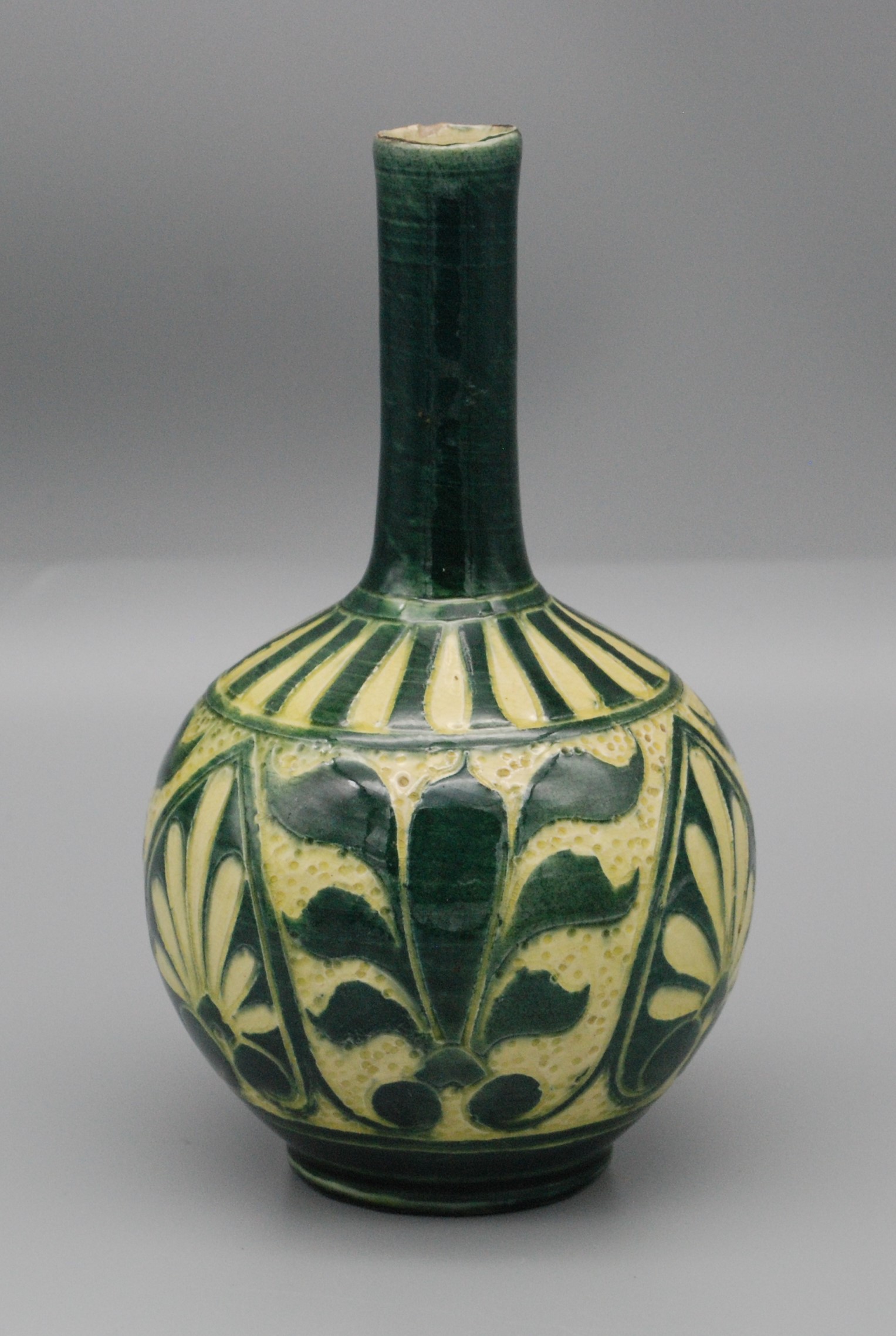
This striking bottle vase, measuring 15.5cm in height and 8.5cm in width, is a fine representative example of the distinctive sgraffito ware produced by C.H. Brannam at the end of the 19th century. Dated 1890, the vessel is defined by a classic globular body that sharply transitions into an elongated, slender neck, resting upon a short, neat foot rim.
The tactile surface showcases a highly disciplined use of the sgraffito technique, juxtaposing a rich, glossy forest green glaze against a pale, cream-colored stippled ground. The decoration is strictly structured: the shoulder features a bold, radiating striped motif that anchors the base of the neck. The primary body is divided into panels by sweeping, arched green borders that frame stylized, symmetrical botanical and palmette designs. The intricate stippling of the negative space provides substantial depth and texture, typical of Brannam’s best art wares.
The underside bears the clearly incised signature “CH Brannam Barum 1890”, firmly dating its production. The vase presents in excellent antique condition, retaining a vibrant and lustrous glaze. There is a minor 4mm nibble to the interior of the top rim, which is historically consistent with the fragile nature of the earthenware body and does not detract from the piece’s strong display presence.
Doulton Lambeth Emily Stormer Foliate Vases
For sale for the pair, are these beautifully executed Foliate vases, demonstrating the very best of Doulton Lambeth Arts & Crafts as the classical period moved towards Art Nouveau. By Emily E. Stormer, one of my favourite Lambeth artists, she has not held back in the execution of these vases.
Offered in excellent original condition, the vases are both clearly signed with Emily Stormer’s initials, the assistant marks and the round “cog” and “England”, dating these vases to the 1890s. Buy the pair as a real statement. You will not be disappointed.
Doulton Lambeth Frank Butler Early Jug
£225.00
In 1873, Arthur Barlow crafted a remarkable Doulton Lambeth ewer, a testament to his exceptional skill and artistic vision. This ewer, notable for its generous proportions, is adorned with intricate scrolling beadwork, florette roundels, and elegant foliate designs. Characteristic of Barlow’s style, it features his distinctive banding in the background, adding depth and texture to the piece. The top of the ewer is crowned with a solid sterling silver lid, which is original and was crafted in London in 1873 by the esteemed silversmiths Richards & Brown.
The condition of this ewer is impeccable; it remains in its original state with no chips, cracks, or restoration, preserving its historical and aesthetic value. Beneath the foot of the ewer, one can find Arthur Barlow’s signature alongside the Doulton Lambeth oval stamp, authenticating its origin and craftsmanship.
Doulton Lambeth Hannah Barlow Cats Biscuit Barrel
For sale we have this outstanding quality Hannah Barlow biscuit barrel decorated with six cats in various states from relaxation to spats! The navy sgraffito work is some of the best we’ve seen and is a testament to her skills as a master ceramicist at Doulton Lambeth. This piece looks so good we decided to display it for a couple of years before deciding to put it up for sale. The barrel boasts one large work of a sleeping cat, two cats having a stand-off spat, and three others sitting and socialising. Such as endearing piece. The top and bottom borders are bands of mini florettes and blue rush groups repeated all the way around. Two blue lug handles finish the effect on either side.
Condition wise, there are a few things to mention here. First, and rather obviously, the lid has gone missing and this is an old replacement lid that came with the piece when we acquired it. The original lid would have been stoneware. Secondly, the top rim has two nibbles (one 5mm and the other 1mm) and the top inside rim also has two nibbles (one 8mm and the other 5mm). The base edge has one 2mm nibble. Other than this, there are no other cracks, chips or any restoration to the piece. The photos clearly show the condition. Beneath, we have Hannah Barlows “HBB” monogram together with the shape code 498 and the Doulton Lambeth cog and “England” present and correct. This places the production of the piece around the early 1890s.
If as a collector you can look past the lid and a few nibbles to the tremendous quality of this example, this is a piece that will give you a lot of enjoy.
Martin Brothers Imp playing the blocks
Martin Brothers Imp playing the Blocks – Robert Wallace Martin
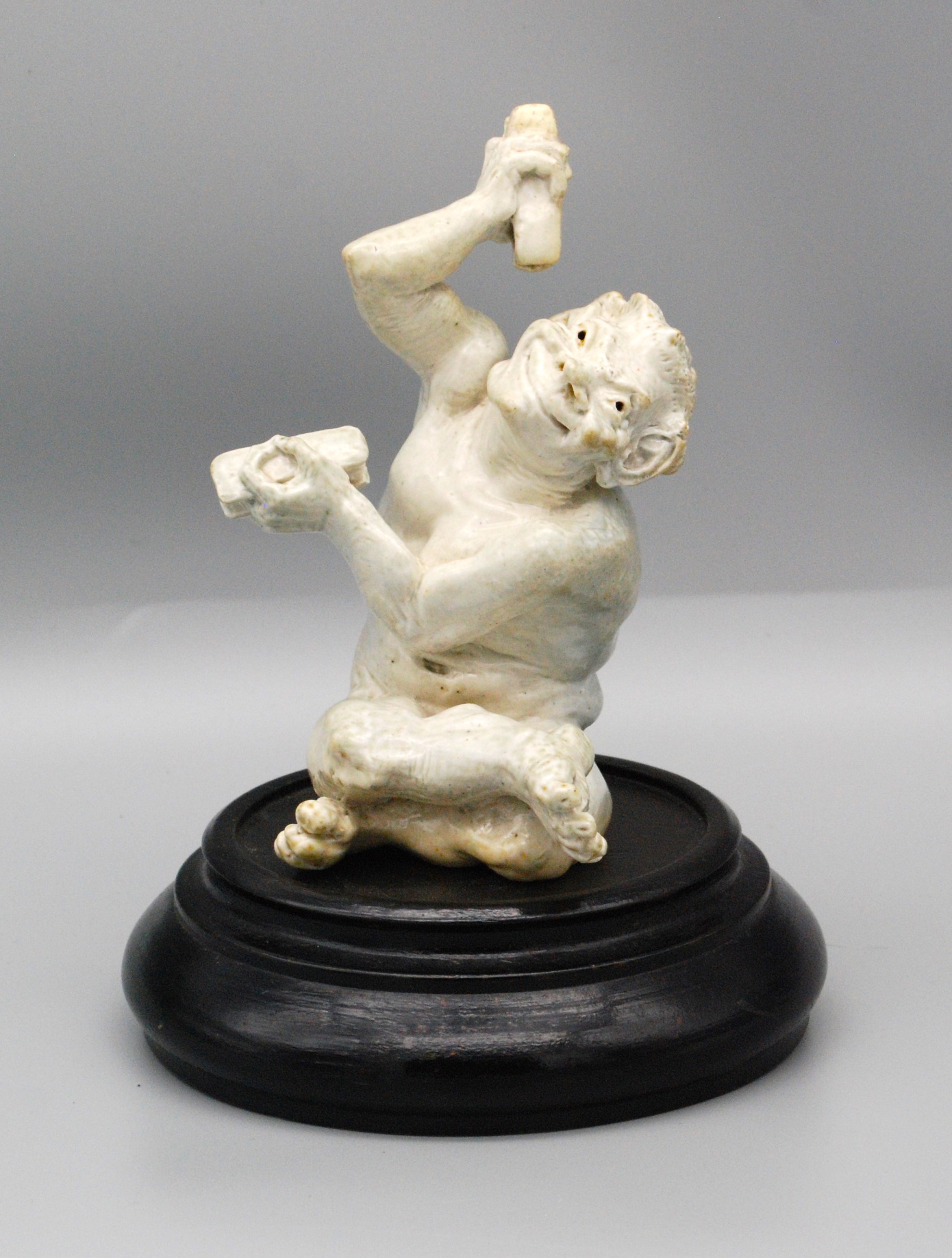
For sale is this delightful and cheeky looking imp playing the blocks. It is in excellent condition, with a very minor old “touch in” to the tip of the block instrument. Otherwise it is in wonderful original condition. It hails from the prominent collection of Barry Stock, a well known collector based out of the UK.
The Martin Brothers Imps are a fascinating and highly collectible series of grotesque figures, each one depicting a whimsical imp engaged in playing various musical instruments. These figures, created by the renowned Martin Brothers, are celebrated for their unique blend of humor, artistry, and intricate craftsmanship. The Martin Brothers—Robert Wallace Martin, Edwin Martin, Walter Martin, and Charles Martin—were pioneers in the field of ceramic art during the late 19th and early 20th centuries. They are best known for their imaginative and often eccentric creations, which have garnered a dedicated following among collectors and art enthusiasts.
Robert Wallace Martin Very Early Mustard Pot
Early R.W. Martin Salt-Glazed Mustard Pot (April 1874)
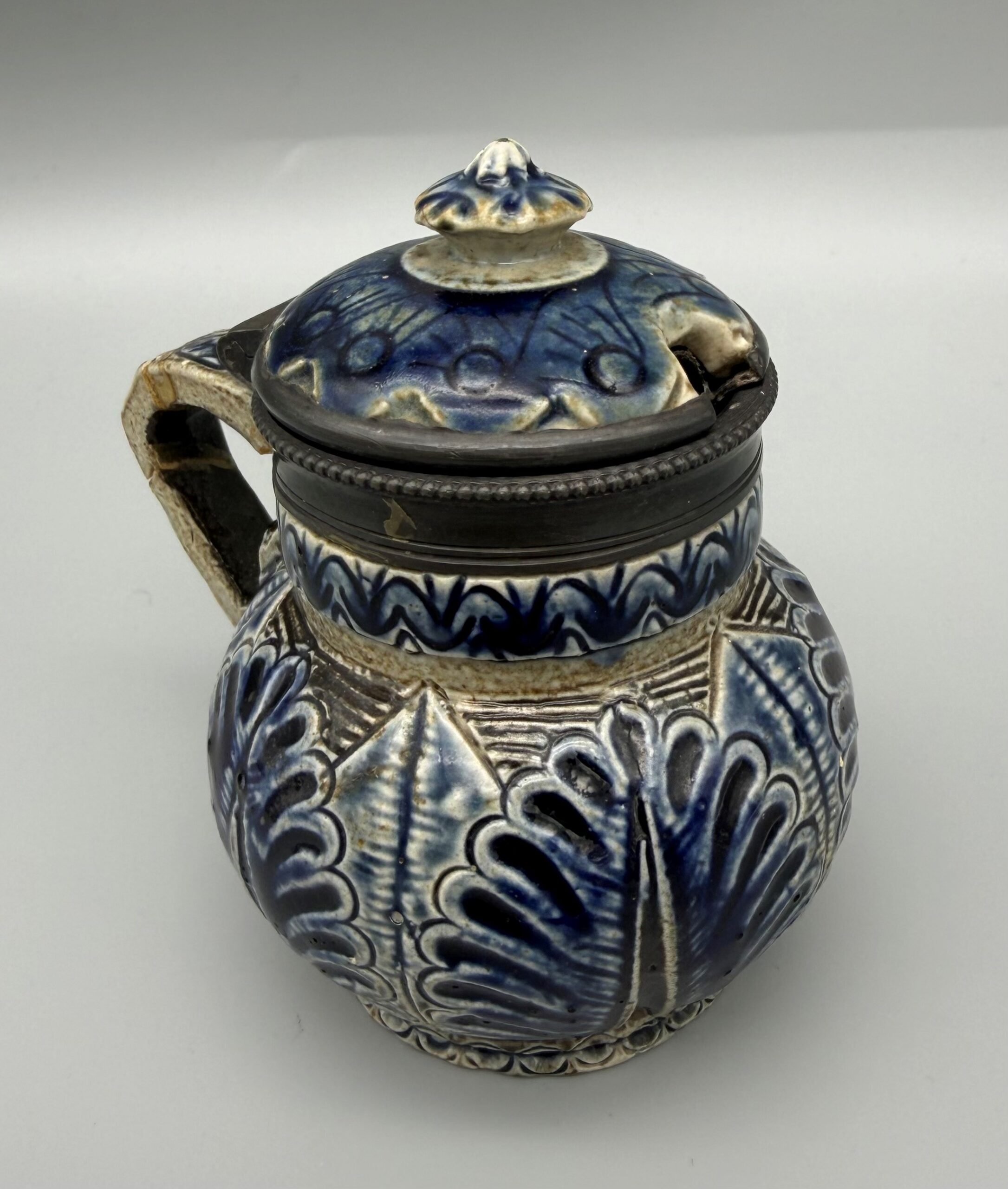
This historically significant salt-glazed mustard pot, measuring 9cm in height and width, represents a rare early work by Robert Wallace Martin. Dated to April 1874, the piece features a squat, bulbous body transitioning to a structured neck and a domed lid with a sculpted finial. It retains its original pewter metal hinge mount, complete with a traditional spoon aperture.
The vessel is heavily decorated, utilizing a deep cobalt blue glaze that contrasts sharply with the textured buff stoneware ground. The exterior displays a vigorous, deeply incised pattern of stylized foliate and fern-like motifs around the lower body. This is complemented by a continuous band of repeating wavy arches at the neck and radiating petal designs upon the lid.
The underside bears the clear, incised signature “R W Martin”, alongside the pattern code “A36” and the date “4-74”, firmly placing its production in the pivotal early months of Wallace’s independent career.
Condition & Restoration Opportunity: While the main body, metal mount, and lid present strongly, the angular handle has sustained four breaks and currently exhibits old, crude adhesive repairs. This presents an excellent, straightforward project for a professional ceramic restorer or a dedicated collector. Once sympathetically restored, this piece will stand as a highly displayable and historically important 1870s artifact.
Shop Grid – 3 Columnsnickgt12021-03-01T16:11:38+00:00