Doulton Lambeth Elizabeth Fisher Bowl
£245.00
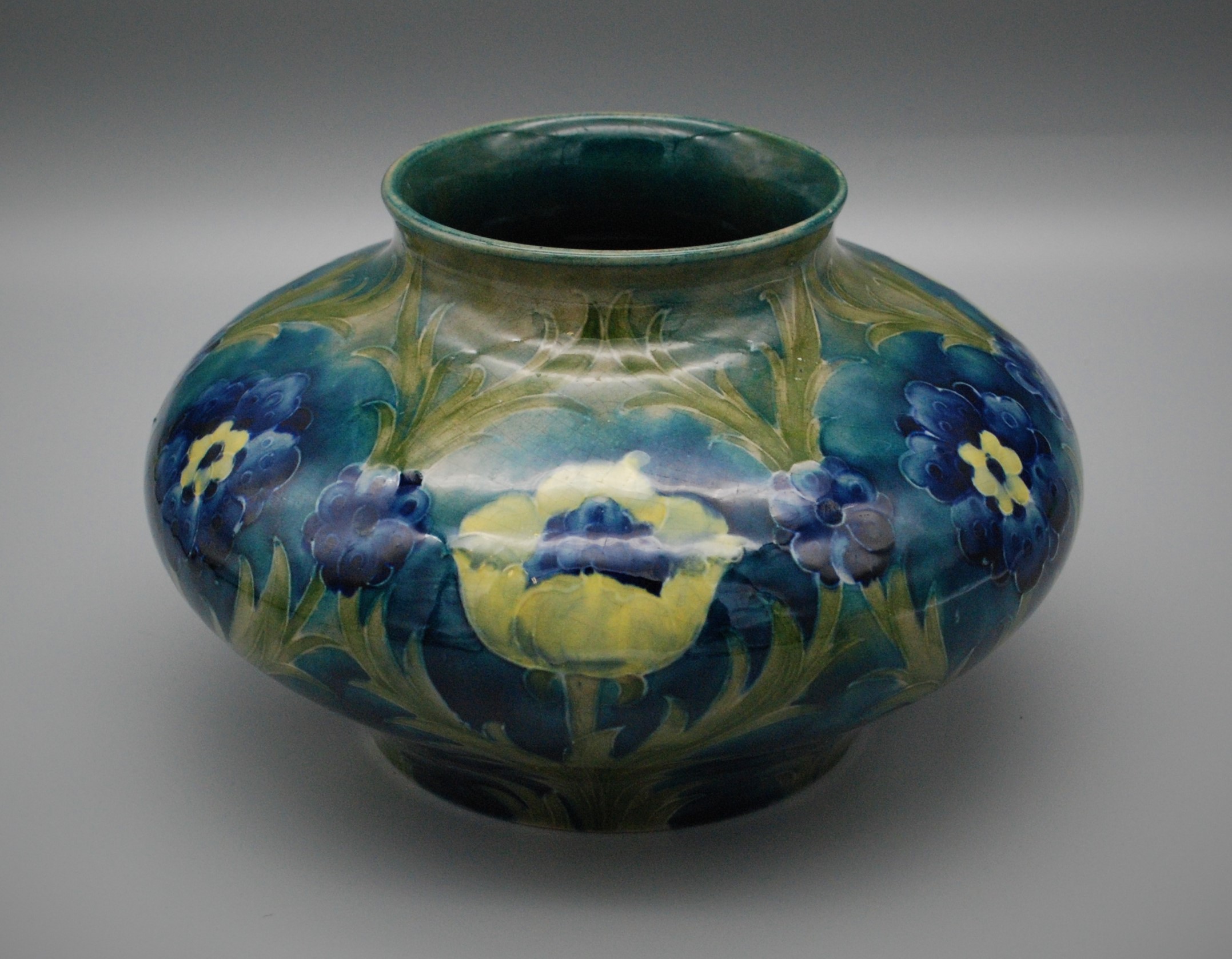
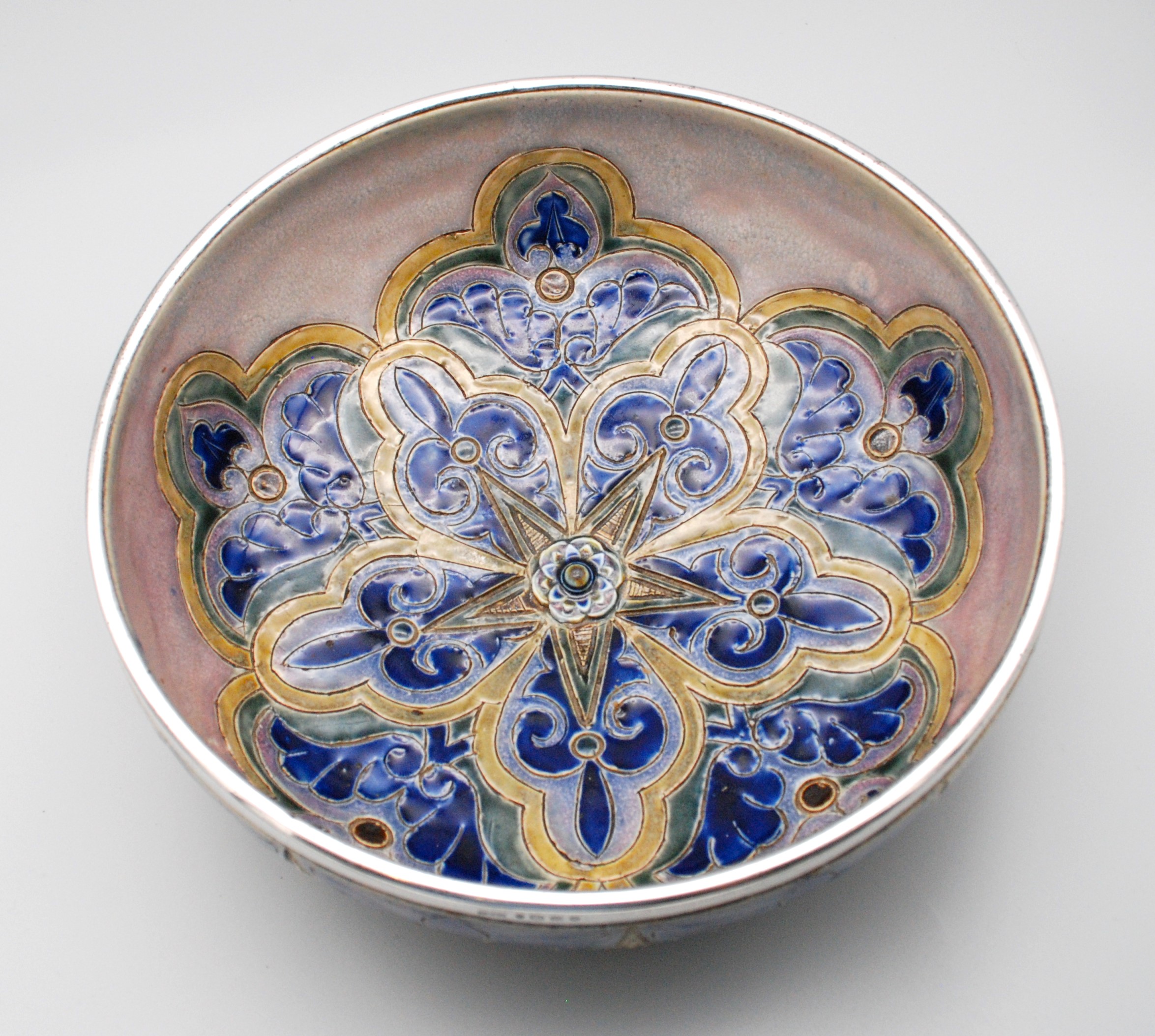
For sale we have a stunning, large Doulton Lambeth bowl by artist Elizabeth Fisher, dating to 1882. The colours and designs both inside and out on this bowl are of the first order, with geometric shapes integrated into softer rounded shapes. The collour way is exquisite – we have rich blues in the centre of the designs, followed by light blue, yellow and then purple and pink to create a most striking bowl. The edge is rimmed with solid silver, made in Birmingham and is original to manufacture.
The Bowl is free from any chips, cracks or restoration. The silver rim is original. Beneath we have Eliza Fisher’s signature, together with the marks of the assistant and thrower, a code “327” and the Doulton Lambeth cog stamp with the date 1882.
Doulton Lambeth George Tinworth Jug 1874
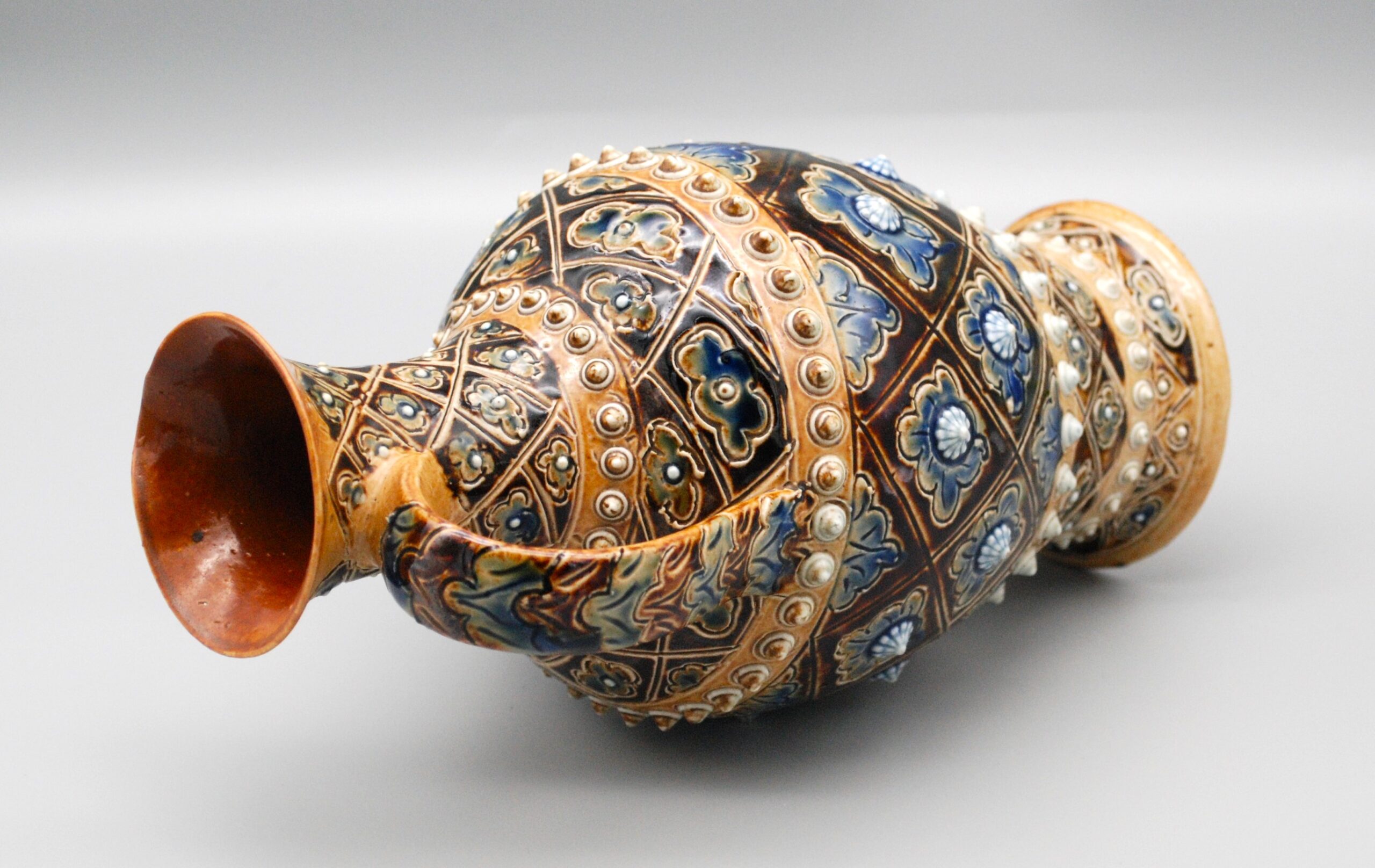
For sale is a very early Doulton Lambeth jug by their most famous artist, George Tinworth. Dated 1874, in our opinion this piece represents a rarer and finer quality work by Tinworth. Unusually, the Seaweed Scroll work is absent on this piece, as George has decided to work towards a different effect. He has used the beading which is large and raised (sharp to the touch) to create four horizon borders. He has then crossed diagonal lines to create a diamond criss-cross effect. Within each diamond segment is then decorated blue bulbous forms which house intricate florette roundels to the centre diamonds, and beads to the smaller areas. The background is coloured to mid-brown.
Beneath, the jug is stamped with the early oval Doulton Lambeth mark and dated 1874. Further it has George’s monogram clearly engraved and that of an assistant or thrower. The jug is in fabulous condition, with only a very minor professional, invisible restoration to a small top rim chip. The quality of this jug will delight any serious early Doulton or Arts & Crafts collectors!
Martin Brothers Early Small Jug
Martin Brothers Early Stamped Small Jug
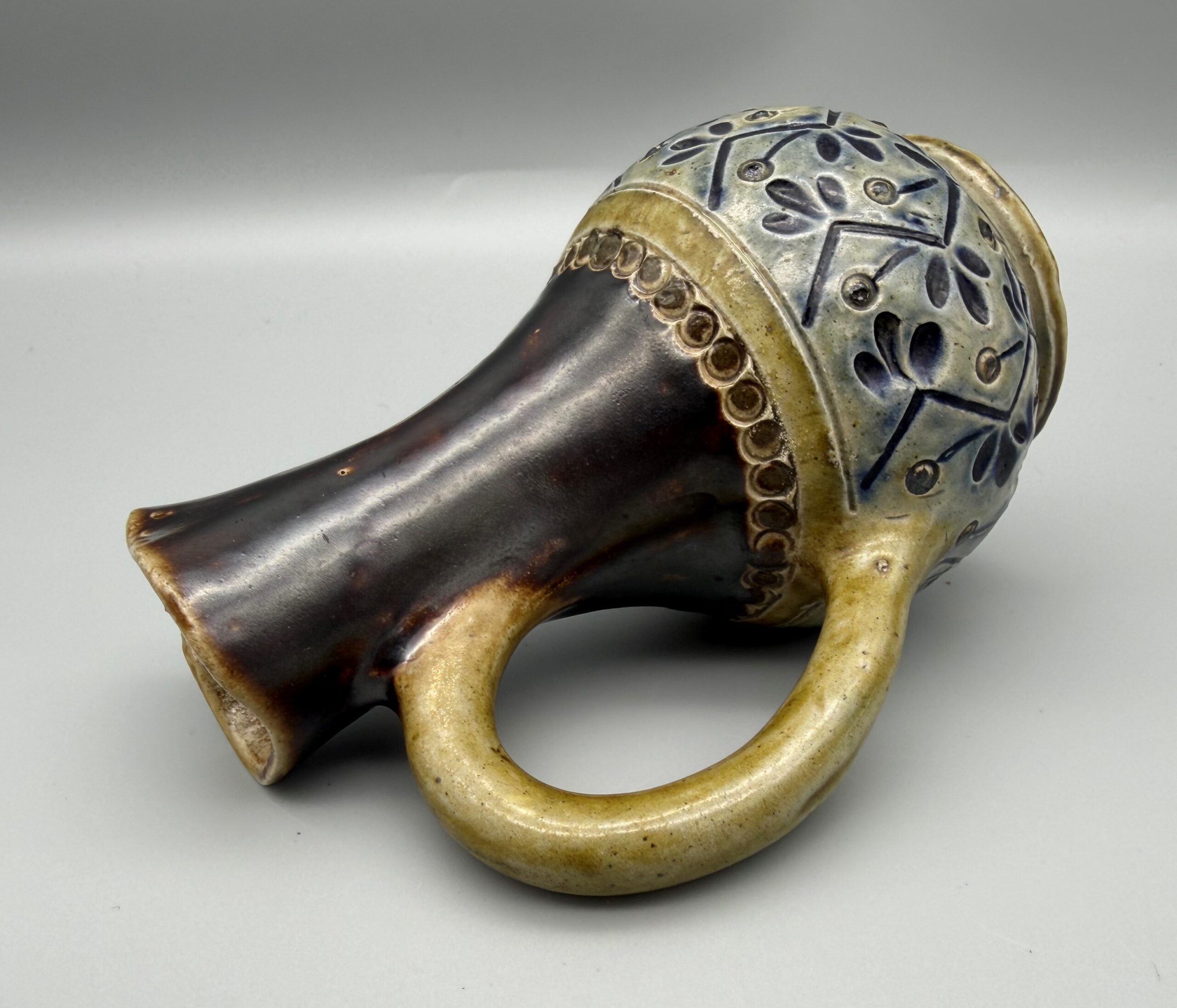
For sale is this truly delightful early Martin Brothers jug, dated 23-06-1880. Rare to find, this jug is stamped with the early “R.W. Martin Southall” stamp which dates it authentically to 1880.
To the top half, the jug has been coloured with a mix of rich brown and light metallic oxides to give the brown an additional sheen to it. Beneath, bandings of small circles and lines separate the brown top section from the framing of the zig-zag simple foliate and flower desgned motifs. A subtle olive-green presents in the centre bandng and onto the jug handle for further contrast to this wonderful early piece.
Beneath, the R.W. Martin Southall” stamp is clear as well as the hand-inscribed date of 23-06-1880.
This piece is in wonderful orginal condition and is free from any chips, cracks or repairs. It measures 14cm tall by approximately 10.5cm wide including the handle.
This is Martin Brothers in its simple authenticity, in wonderful condition. Adding it to your collection will not disappoint and it is a lovely size for a cabinet.
Doulton Lambeth Florence Barlow Bird Bowl
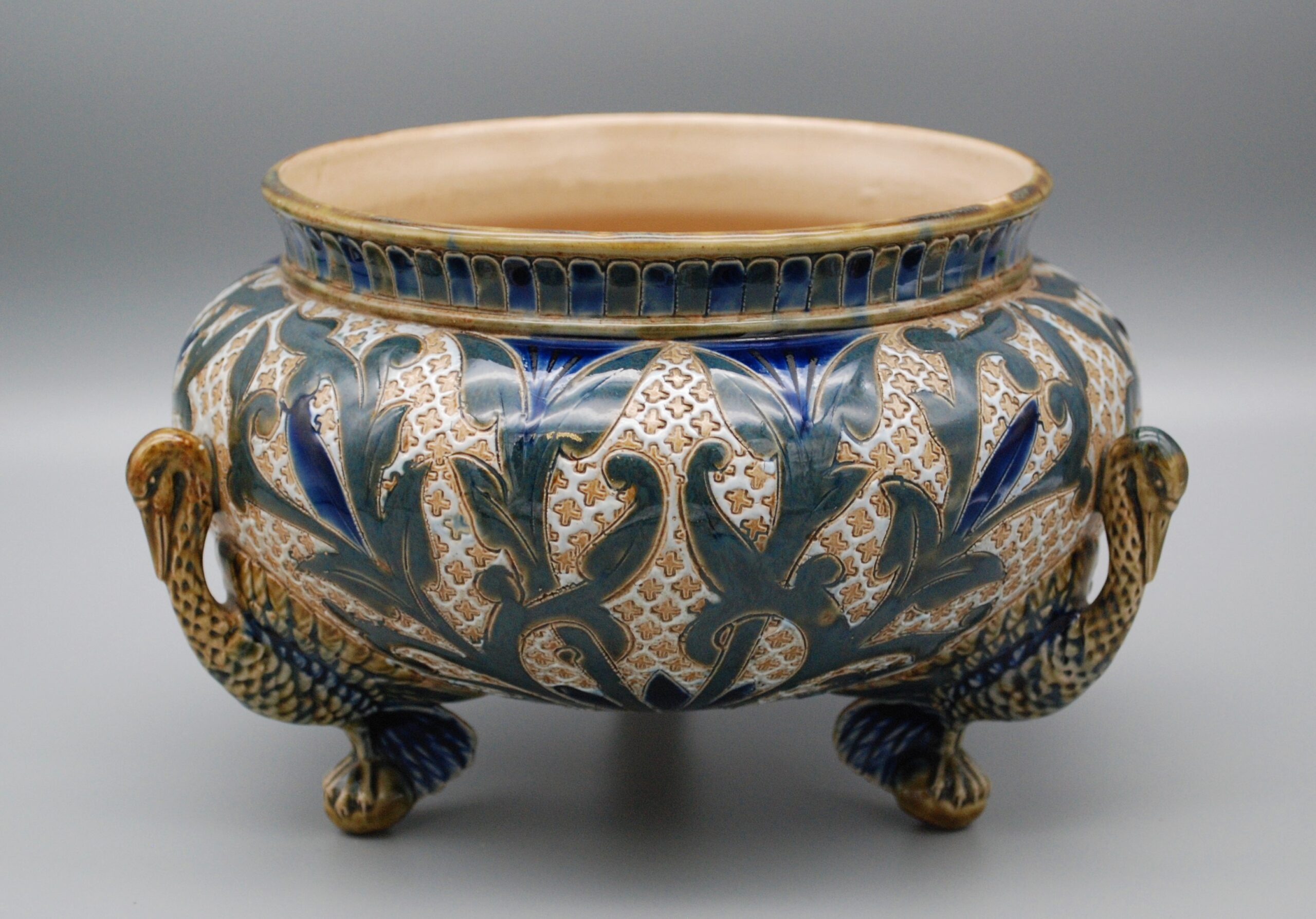
For sale is what can only be described as an “uber-rare” Doulton Lambeth bowl by renowned artist Florence Barlow. It dates to 1877 – a lovely early piece. With birds in relief scrolling down to form feet, this is the only piece of its kind I have seen by Florence Barlow, or even remotely similar! Florence focussed on birds – yes – but she painted remarkably realistic birds in the pate-sur-pate technique onto the facia of her pieces. On this earlier piece, Florence has executed beautiful and bold aesthetic design to the main body, of which I have seen examples before. She has then opted to add three birds gracing the sides and footing of the bowl, which take its quality to the next level.
The bowl stands 13.5cm high but significantly wider at 23cm. It therefore has a lovely presence and its moderate size would suit a collectors cabinet or be a centre piece on a hall table, sideboard or mantle.
Presented in outstanding original condition, there are no chips, cracks or restoration. The bowl beneath shows the round Doulton Lambeth stamp and date 1877. It further shows the signature of Florence Barlow “FEB” together with assistant marks and code numbers.
Doulton Lambeth George Tinworth Vase
£265.00
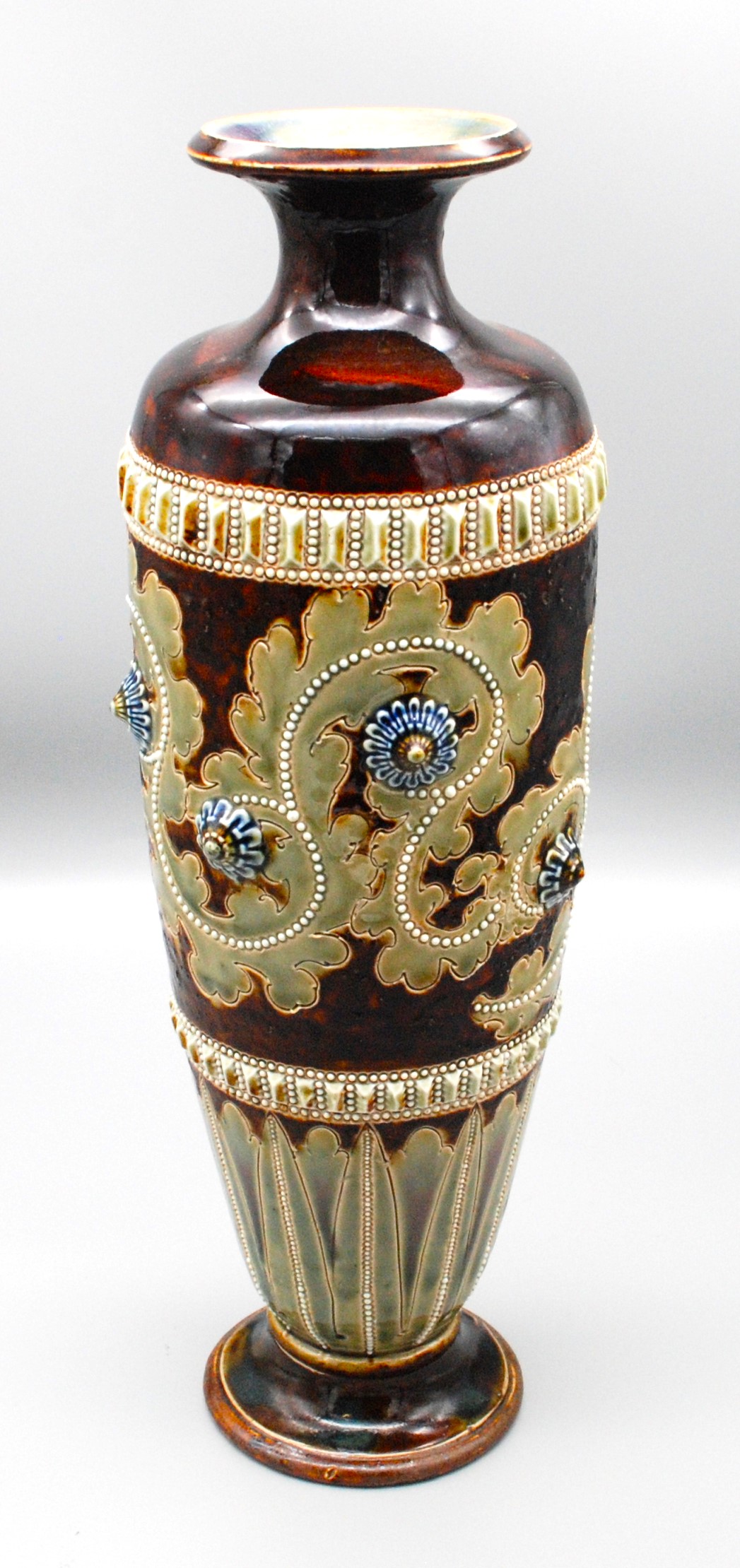
For sale we have this tall and commanding Doulton Lambeth vase by George Tinworth. It is an early piece, dating to 1876.
George has used his signature “Seaweed Scroll” design across the vase to great effect, with subtle green seaweed contrasted against a rich brown background. The beading work to the scrolls is refined and delicate. Geometric tactile borders reside above and below the scrolling, with vertical leaf patterns extenuating the narrow base section to give interest and play to its height. The leaves also have subtle purples and pinks in them, which really adds to the piece overall. Inside the rim, the purple is evident again and adds further contrast to a well executed vase by Doulton Lambeth’s master artist.
Presented in undamaged original condition, the vase is stamped correctly beneath with the oval Doulton Lambeth stamp and the date 1876. This vase was originally one of two, and only one was signed with the GT monogram to the main body, which was a typical scenario. The picture of the other vase is provided below as proof that this piece is 100% a George Tinworth vase. Offered for sale at a very competitive price. The buyer will not be disappointed!
Doulton Lambeth Arthur Barlow FA Cup Pitcher
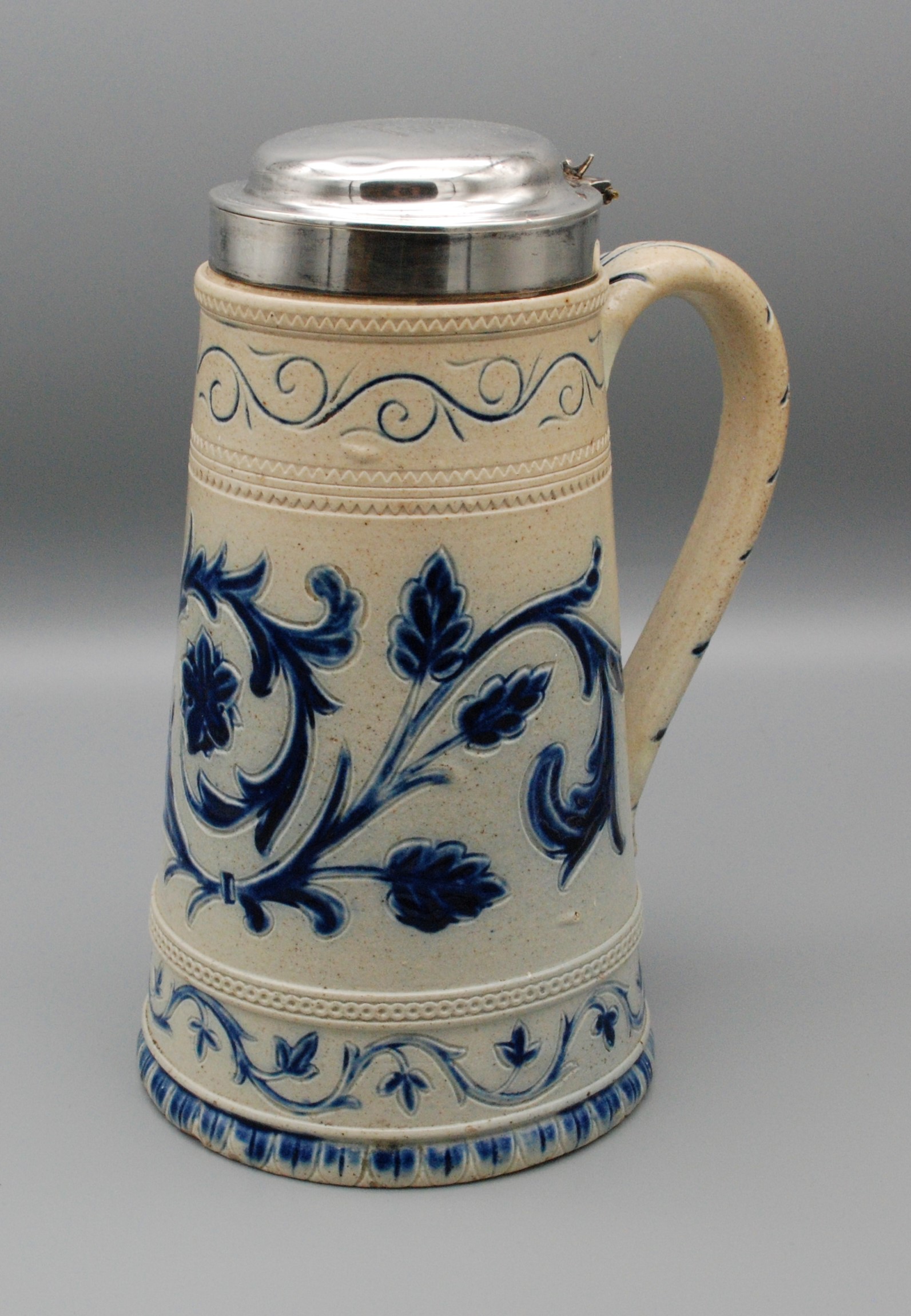
For sale is a very early Doulton Lambeth pitcher by Arthur Barlow with a unique story. This pitcher belonged to one of the players responsible for the very first inaugural FA Cup win in 1872. William Crake (aka William Parry), playing for Wanderers FC in 1872, claimed a 1-0 victory at Kennington Oval over a tough game with the Royal Engineers.
The pitcher itself is a highly desirable piece in the typical early style and colours of Doulton and Barlow. With the main body decorated with bold blue scrolling florals, there are miniature scrolling floral borders above and below. Further tactile anglular pattern borders sit below the lid, between the scroll work and to the base. The handle is decorated with a simple leaf venation pattern. The top is adorned with the original solid silver rim and lid. To top centre is the Crake family crest, and inside the lid is a lovely crisp inscription “To William Parry Crake from E.N.C. February 11th 1873.” with decorative embellishment.
This early piece is in very good condition. Professional stabilising of the handle is evident, and there are a few minor nibbles to the base commensurate with age. Otherwise, the lid is all original and there is no evidence of any other chips or cracks. The base is stamped with the early oval Doulton Lambeth mark and Arthur Barlow’s “ABB” signature is present and correct.
Martin Brothers Gnarly Olive Jug
Martin Brothers Gnarly Olive Jug
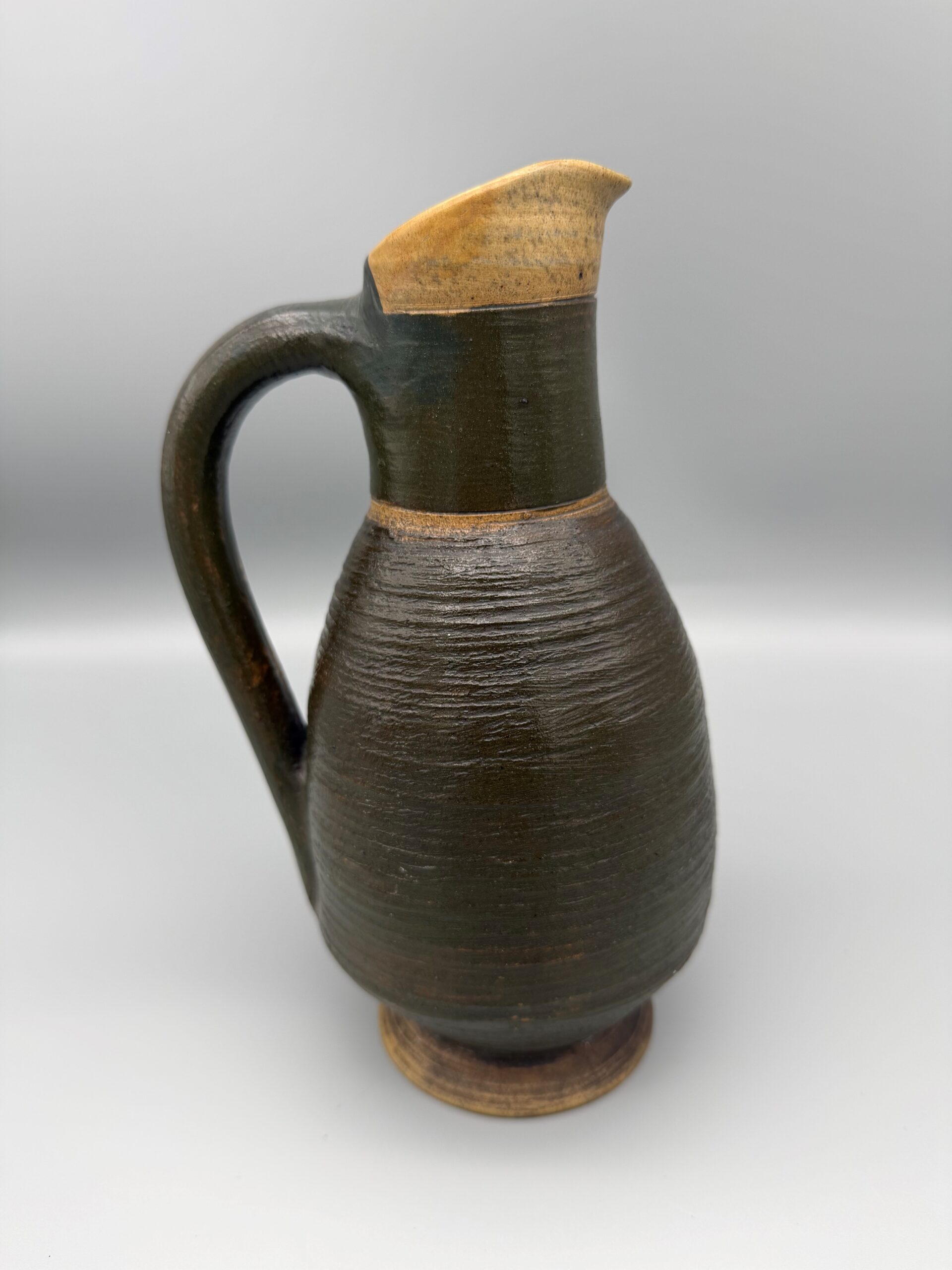
Presenting an exceptional, historic gnarly-designed Martin Brothers art pottery jug, measuring approx. 22.5cm in height and 12.5cm in diameter. This piece from a highly sought-after potter features a robust baluster form jug, resting securely on a flared circular foot. Its gnarly silhouette is defined by a bulbous lower body that tapers into a cylindrical neck, culminating in a sweeping pouring lip and an applied, sturdy strap handle.
The jug is characterized by its tactile, heavily ribbed texture, a testament to its hand-thrown origins by eccentric brothers. A rich, dark olive-brown salt glaze dominates the meticulously textured body and handle. This deep, lustrous finish contrasts strikingly against the lighter, biscuit-toned clay left exposed at the rim, the interior, a thin defining band at the shoulder, and the foot. This earthy, two-tone palette masterfully accentuates the horizontal throwing lines that encircle the entire vessel.
Beneath the foot, the unglazed natural clay base proudly bears the authentic, hand-incised cursive signature reading “Martin” and “London”, securing its prestigious provenance. Preserved impeccably, this remarkable piece presents in excellent, original, and entirely undamaged condition, making it a museum-quality acquisition for discerning collectors of late 19th and early 20th-century British studio pottery.
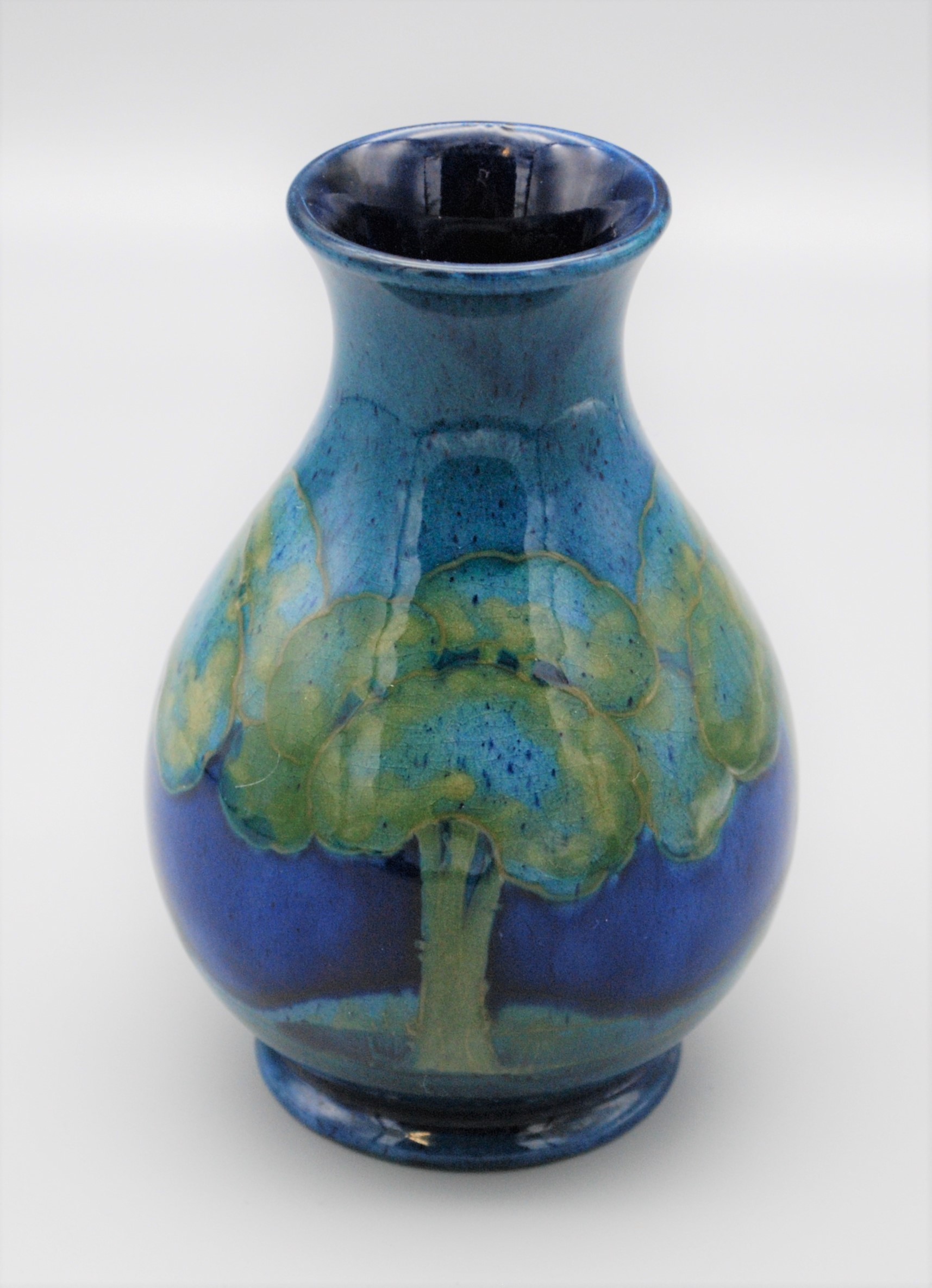
William Moorcroft Small Pomegranate Vase
William Moorcroft Pomegranate Vase – M55 Shape (c. 1910s–1920s)
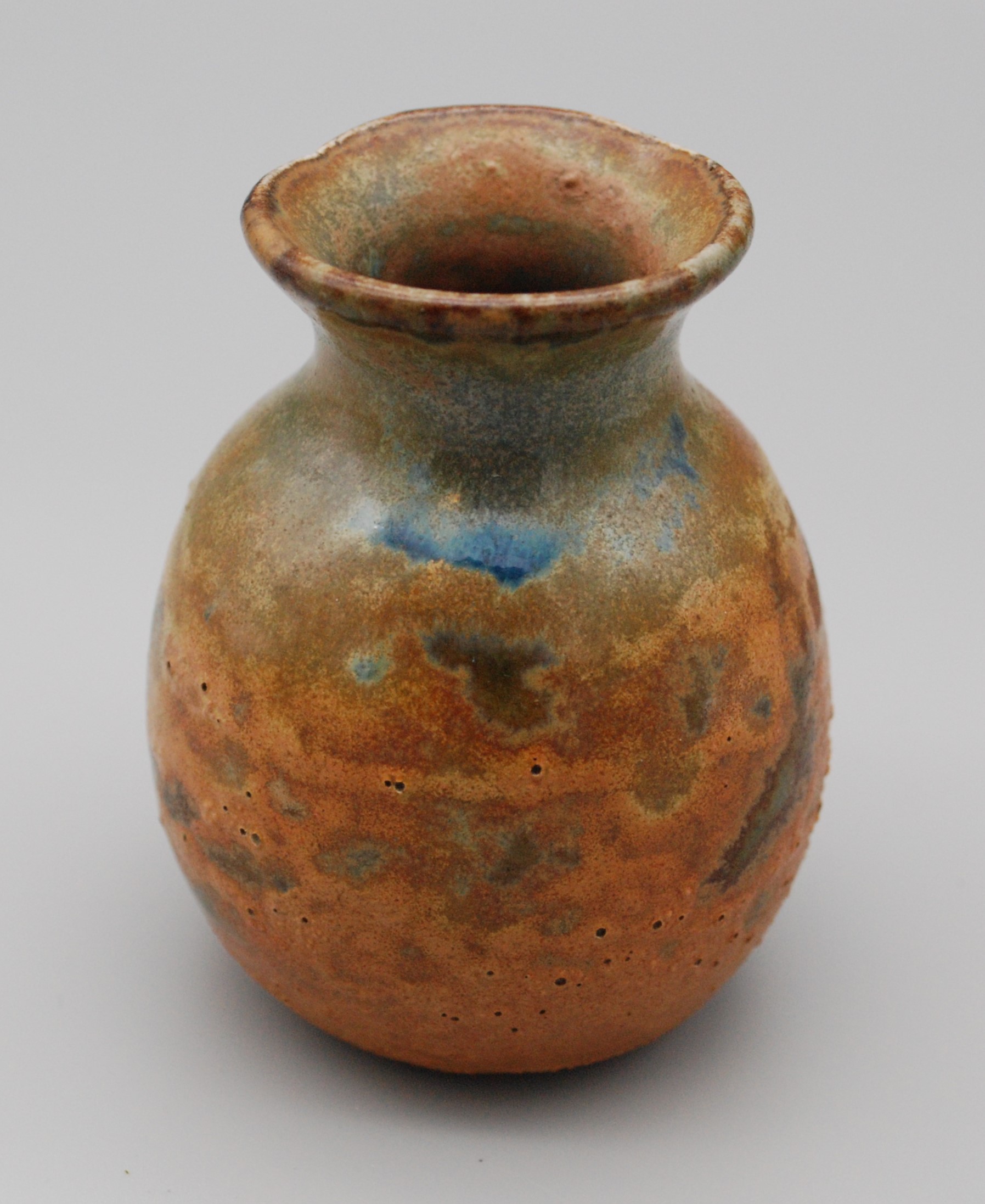
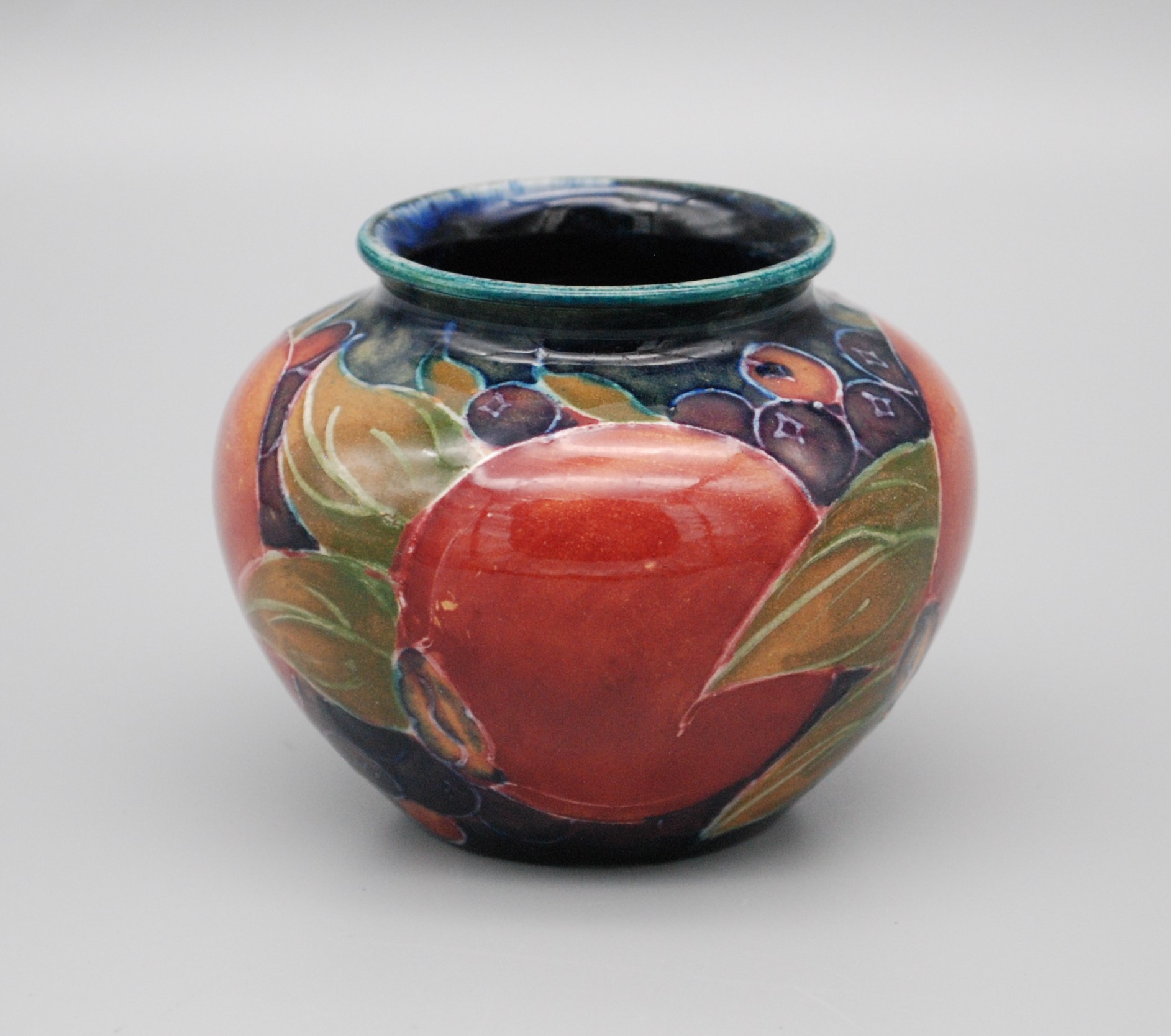
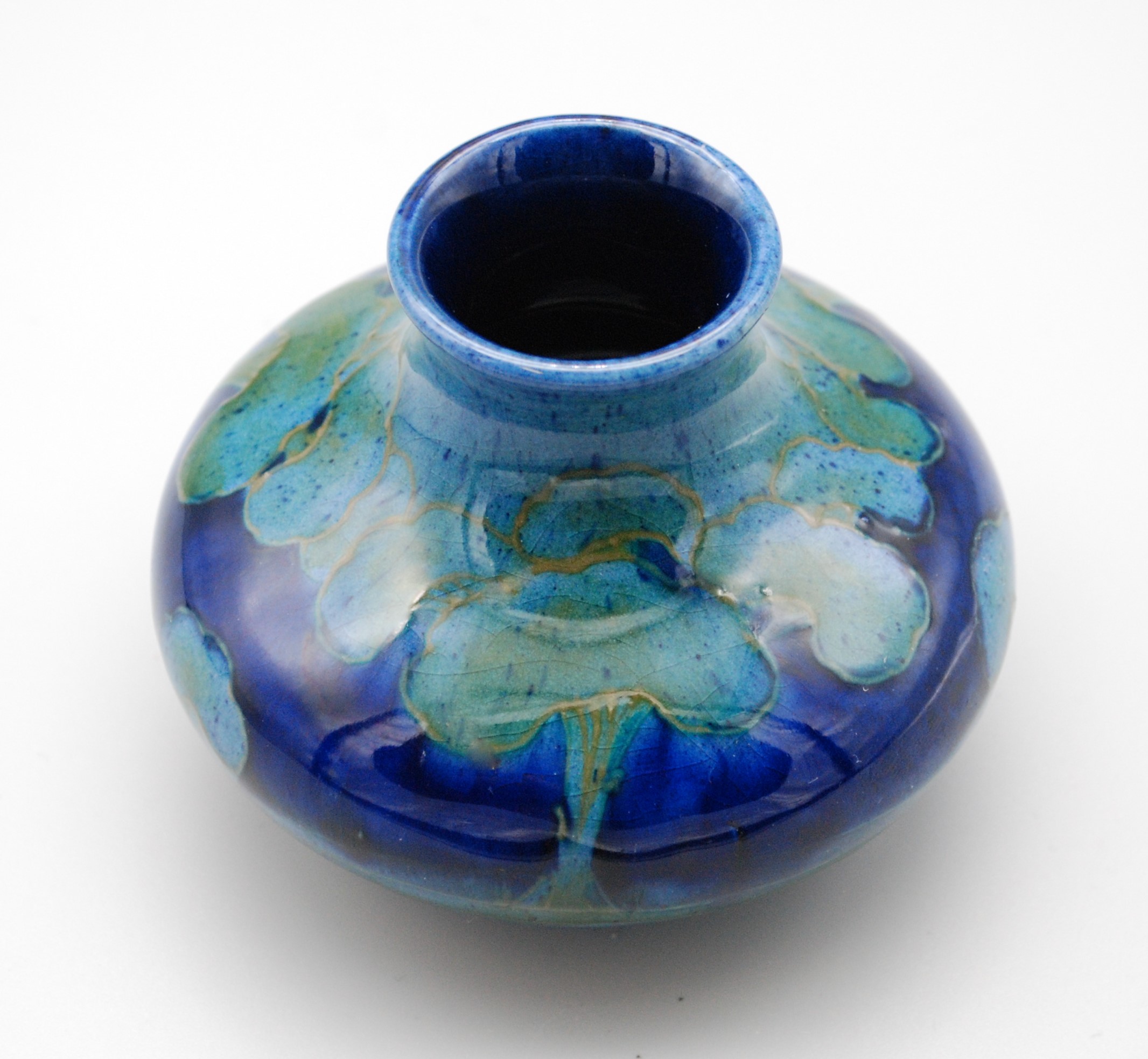
A beautiful example of early William Moorcroft craftsmanship, this small Pomegranate design vase embodies the timeless charm of Moorcroft’s celebrated Burslem period. Measuring approximately 6.5cm in height and 8cm in width, the vase is modelled in the distinctive M55 shape, perfectly proportioned for display.
The decoration features four richly painted pomegranates, evenly spaced around the rounded body, each enhanced with deep green foliage and clusters of blue-purple berries that provide a striking contrast. The design is crowned with a warm ochre glaze running up to and including the rim—an unmistakable hallmark of Moorcroft’s early Burslem output.
To the base, the vase bears a full William Moorcroft signature in green, together with impressed marks reading Moorcroft, Burslem, M55. The piece remains in excellent, unrestored condition, showing only the fine glaze crazing typical of early Moorcroft pottery, with no damage or repairs.
A lovely, well-balanced example of William Moorcroft’s iconic Pomegranate design, this vase would make a fine addition to any Moorcroft collection or serve as a statement piece in its own right.
Doulton Lambeth Florence Barlow Horses Jug
Antique Doulton Lambeth Jug by Florence Barlow, Dated 1874
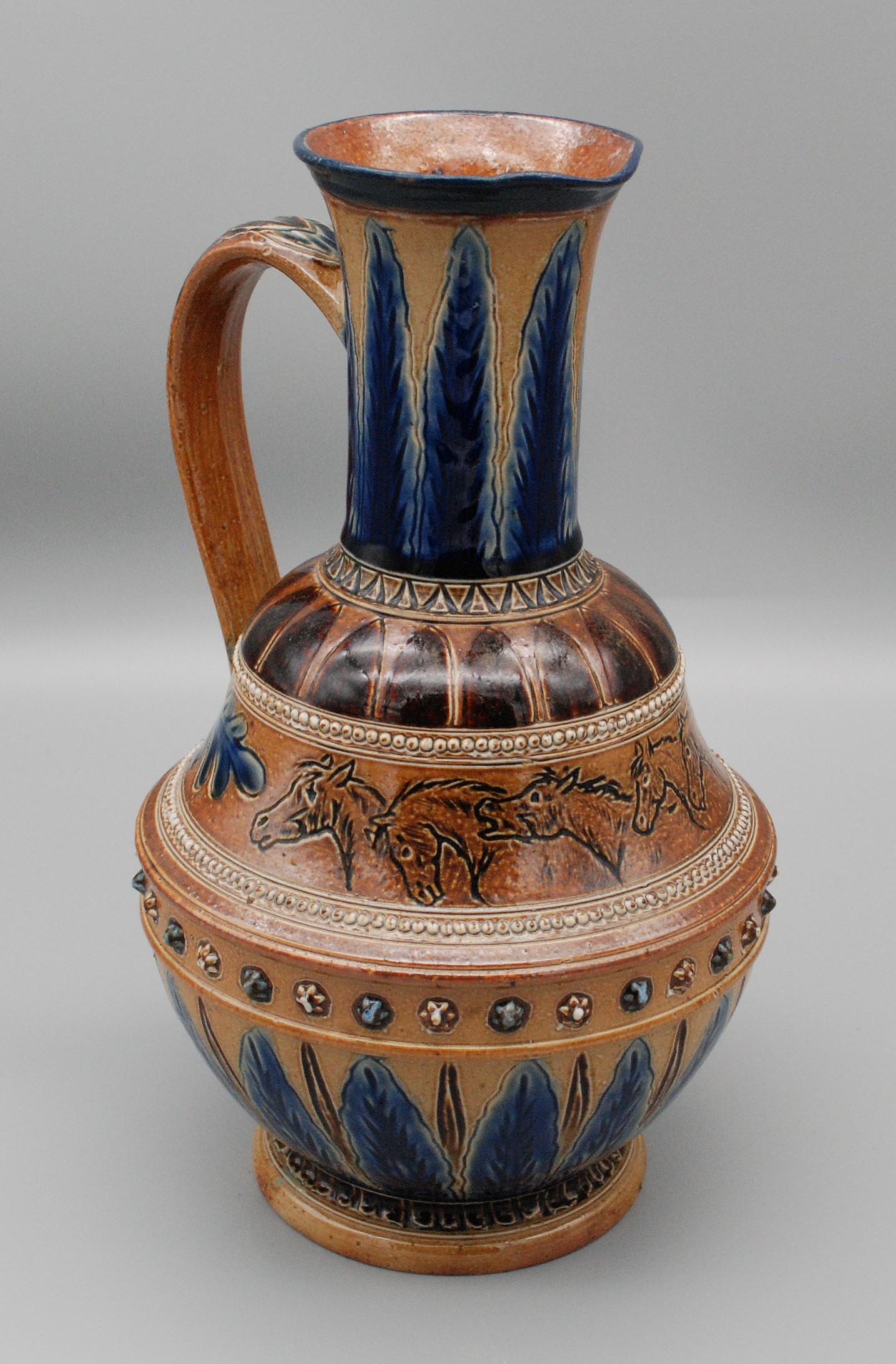
An exceptional early work by a pioneering female artist of the Victorian ceramic movementThis distinguished Doulton Lambeth stoneware jug, dated 1874, is a rare and early example of the artistry of Florence Barlow, one of the most important female designers of the Doulton studio and sister to the renowned Hannah Barlow.
The jug features a finely detailed upper register adorned with seven sensitively modelled horse heads, each emerging from the clay in low relief and encircled above and below by delicate beaded borders. The rendering of the horses—marked by expressive line and form—is particularly notable, as Florence would soon transition to specializing exclusively in birds, leaving animal subjects like these to her sister, Hannah. This piece therefore captures a brief and significant phase in her artistic development.
The slender neck and lower body are decorated with stylized blue foliate sheaf motifs, set within zigzag and florette borders, creating an elegant interplay of texture and design across the jug’s surface. The decorative vocabulary is restrained yet dynamic, reflecting the sophisticated aesthetic typical of early Doulton Lambeth wares.
To the base, the jug bears the oval Doulton Lambeth impressed mark with the date 1874 to centre, alongside an early version of Florence Barlow’s personal monogram, confirming its authenticity and origin.
This piece stands as a rare and important example of early Doulton art pottery and of Florence Barlow’s formative work. It would make a significant addition to any collection of 19th-century British ceramics or women’s art pottery.
Dimensions: Height: 23cm ; Width: 14cm
Condition: The jug has had an older restoration around the rim, where the blue rim border has been repainted. This has been done to a fair standard but due to the age of the repair, there is some age crackling to the restoration. Three florettes have nibbles or chips. Other than this, the vase is untouched.Robert Wallace Martin Very Early Mustard Pot
Early R.W. Martin Salt-Glazed Mustard Pot (April 1874)
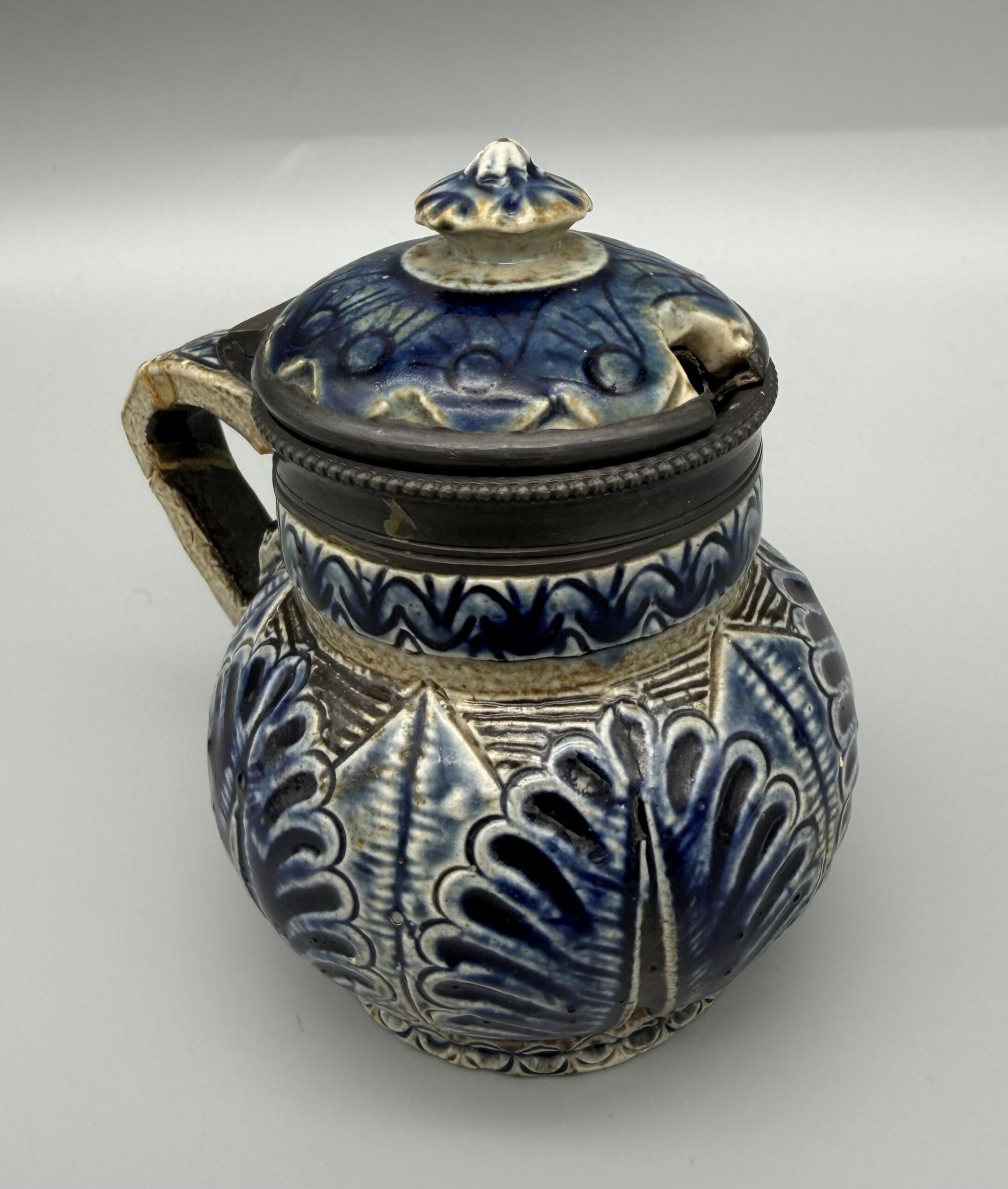
This historically significant salt-glazed mustard pot, measuring 9cm in height and width, represents a rare early work by Robert Wallace Martin. Dated to April 1874, the piece features a squat, bulbous body transitioning to a structured neck and a domed lid with a sculpted finial. It retains its original pewter metal hinge mount, complete with a traditional spoon aperture.
The vessel is heavily decorated, utilizing a deep cobalt blue glaze that contrasts sharply with the textured buff stoneware ground. The exterior displays a vigorous, deeply incised pattern of stylized foliate and fern-like motifs around the lower body. This is complemented by a continuous band of repeating wavy arches at the neck and radiating petal designs upon the lid.
The underside bears the clear, incised signature “R W Martin”, alongside the pattern code “A36” and the date “4-74”, firmly placing its production in the pivotal early months of Wallace’s independent career.
Condition & Restoration Opportunity: While the main body, metal mount, and lid present strongly, the angular handle has sustained four breaks and currently exhibits old, crude adhesive repairs. This presents an excellent, straightforward project for a professional ceramic restorer or a dedicated collector. Once sympathetically restored, this piece will stand as a highly displayable and historically important 1870s artifact.
William Moorcroft Florian Green & Gold Vase
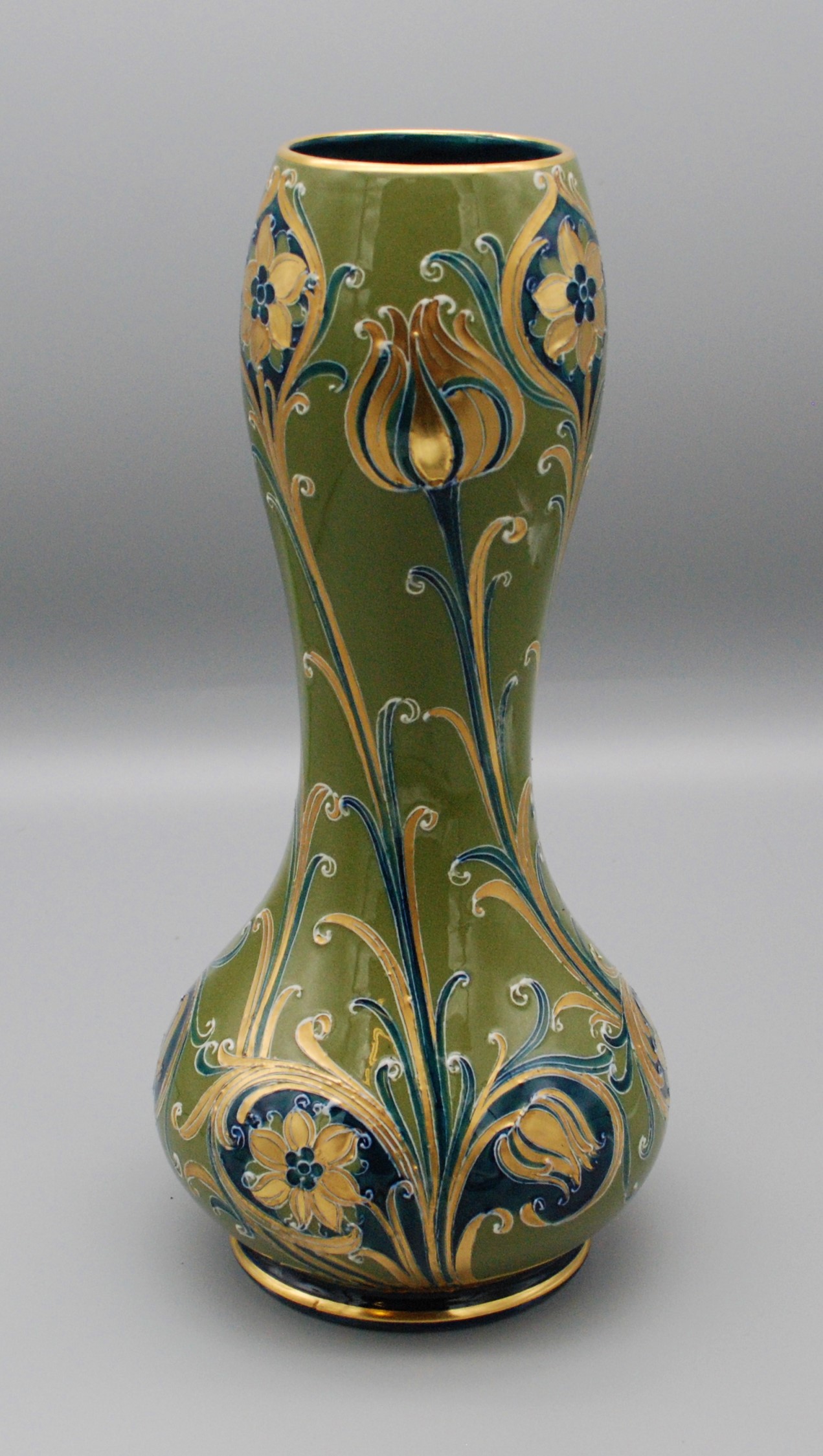
For sale is a piece of Florian “Green and Gold” by William Moorcroft circa 1903-08. In double gourd shape, it is arguably one of the most desirable shapes to secure in your collection. At 27.5cm tall, it is a substantial piece. It counts three flower and tulip buds each to the top of the vase with the same again to the bottom gourd of the vase, so twelve buds in total. The gilt is in excellent condition so this piece really “pops” in a display cabinet.
The vase is being sold in excellent original condition with no damage or restoration. Beneath, the Florian Ware stamp and William’s flash signature in green is present and correct.
Doulton Lambeth Hannah Barlow Miniature Horses Vase
For sale we have a gorgeous Doulton Lambeth miniature Hannah Barlow vase, dating to the turn of the century.
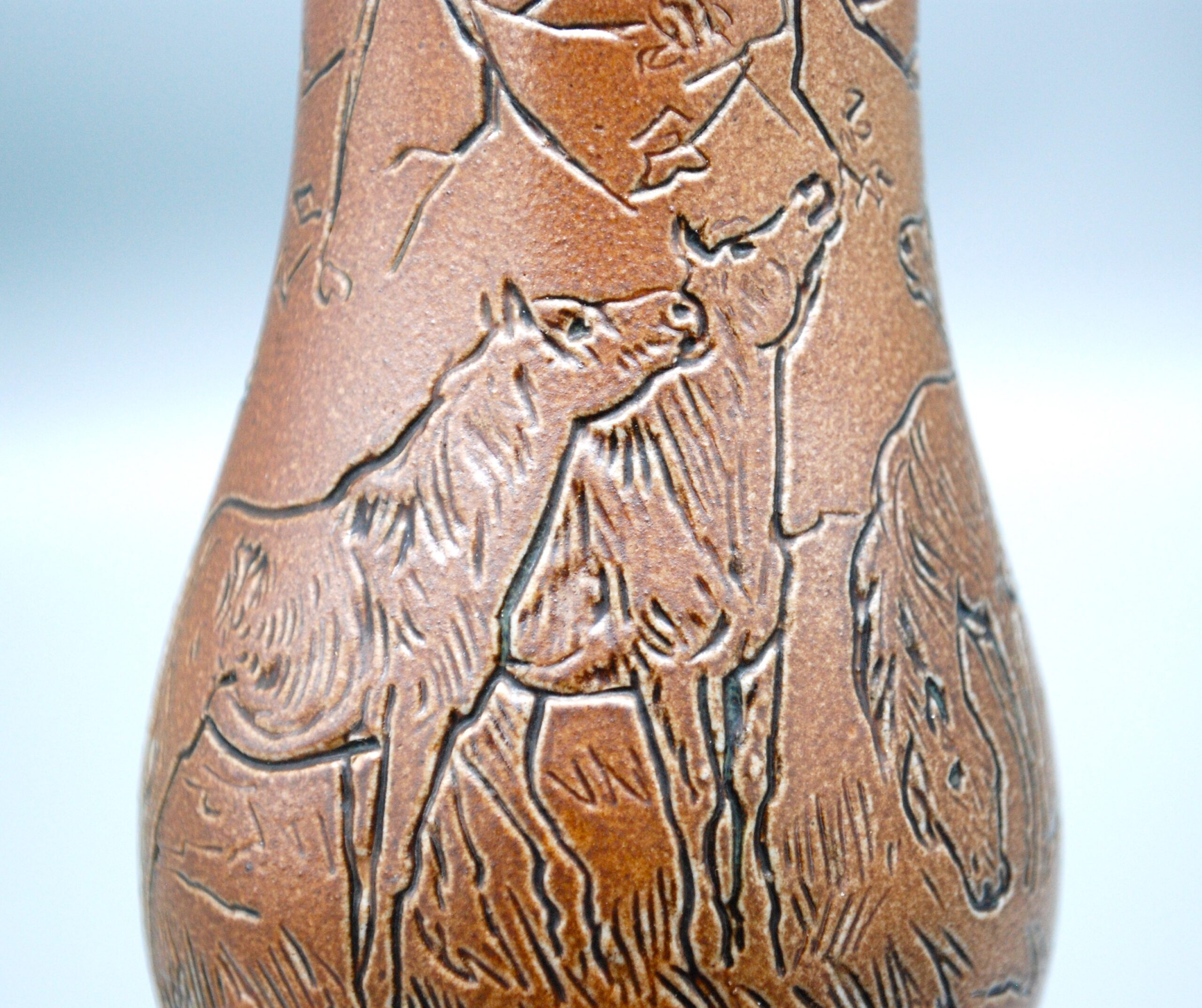
Decorated with five horses eating grass and nibbling tree leaves, this diminutive vase is a true delight. With a bronzed stoneware glaze on which Hannah has worked her sgraffito, it is a warm, charming little piece. It would not surprise if a hint of metallic oxides were used as there is a slight lustrousness to the glaze. Measuring 13cm, or just over 5 inches, there are not many Hannah Barlow pieces of this size around!
Martin Brothers Double Ribbed Vase
Original price was: £895.00.£695.00Current price is: £695.00.
22% Off
Double Ribbed Martin Brothers Lustre vase – June 1907
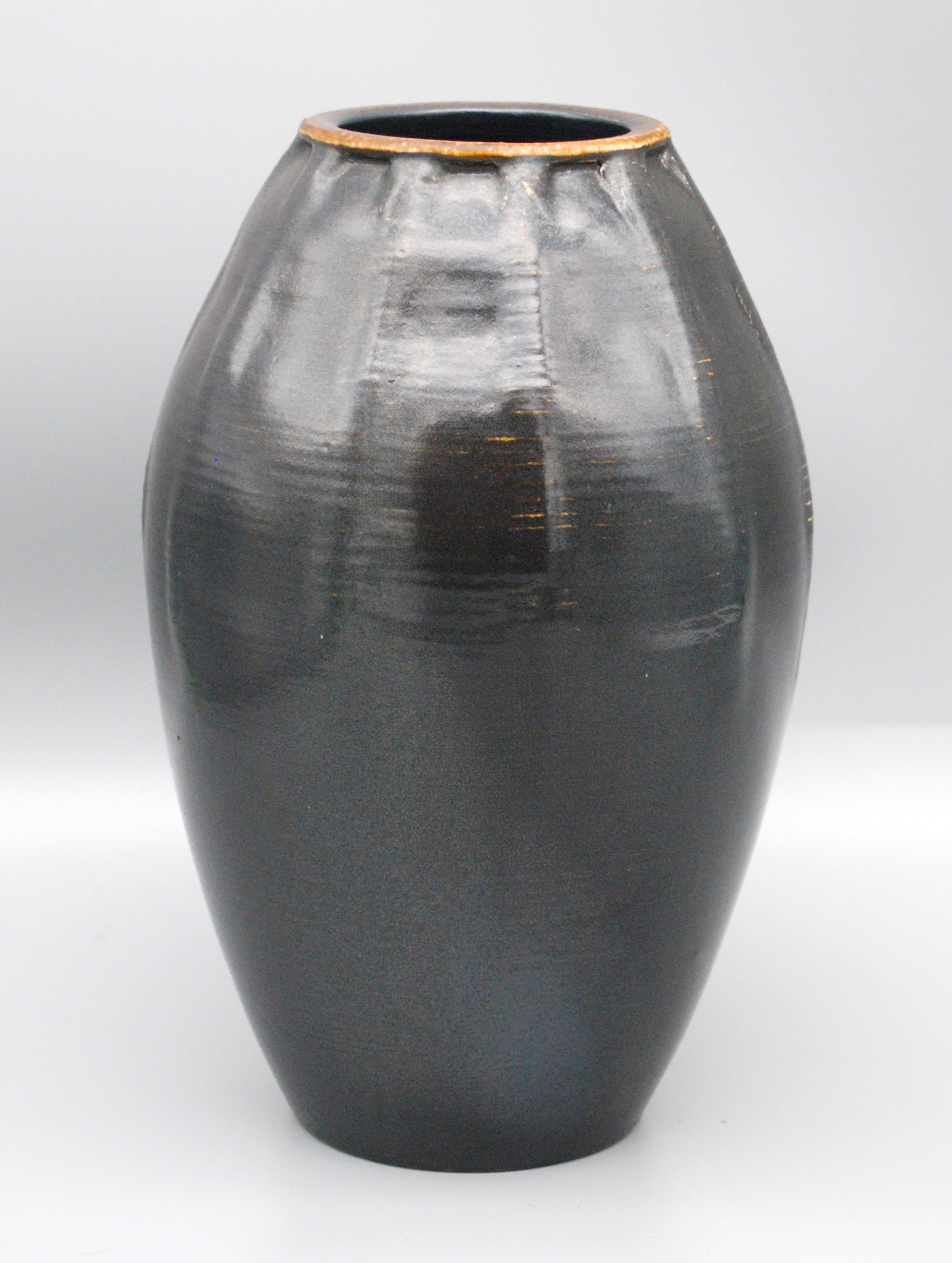
For sale is this really interesting example of Edwin and Walter Martins’ organic pottery work. The vase is of subtle bulbous form, with a multitude of thin horizontal ribs and then large pronouced vertical ribs from the waist to the top rim. The Brothers have then applied a rich deep brown / dark grey / black colour with metallic oxide to give a wonderful lustre to the piece. In the photographs, observe the different angles where we try and illustrate the effect. This is a wonderful example of their work and is a most subtle, yet highly competent execution.
Condition and Provenance
The vase is in excellent original condition, with no chips, cracks, or repairs. A couple of specks on the main body of the vase are small imperfections during the manufacture of the vase. The signature beneath is 100% consistent with period pieces and is marked “6-1907, Martin Bros, London & Southall”, again entirely consistent and authentic. See the V&A Museum picture below of a virtually identical example from the same year by Edwin.
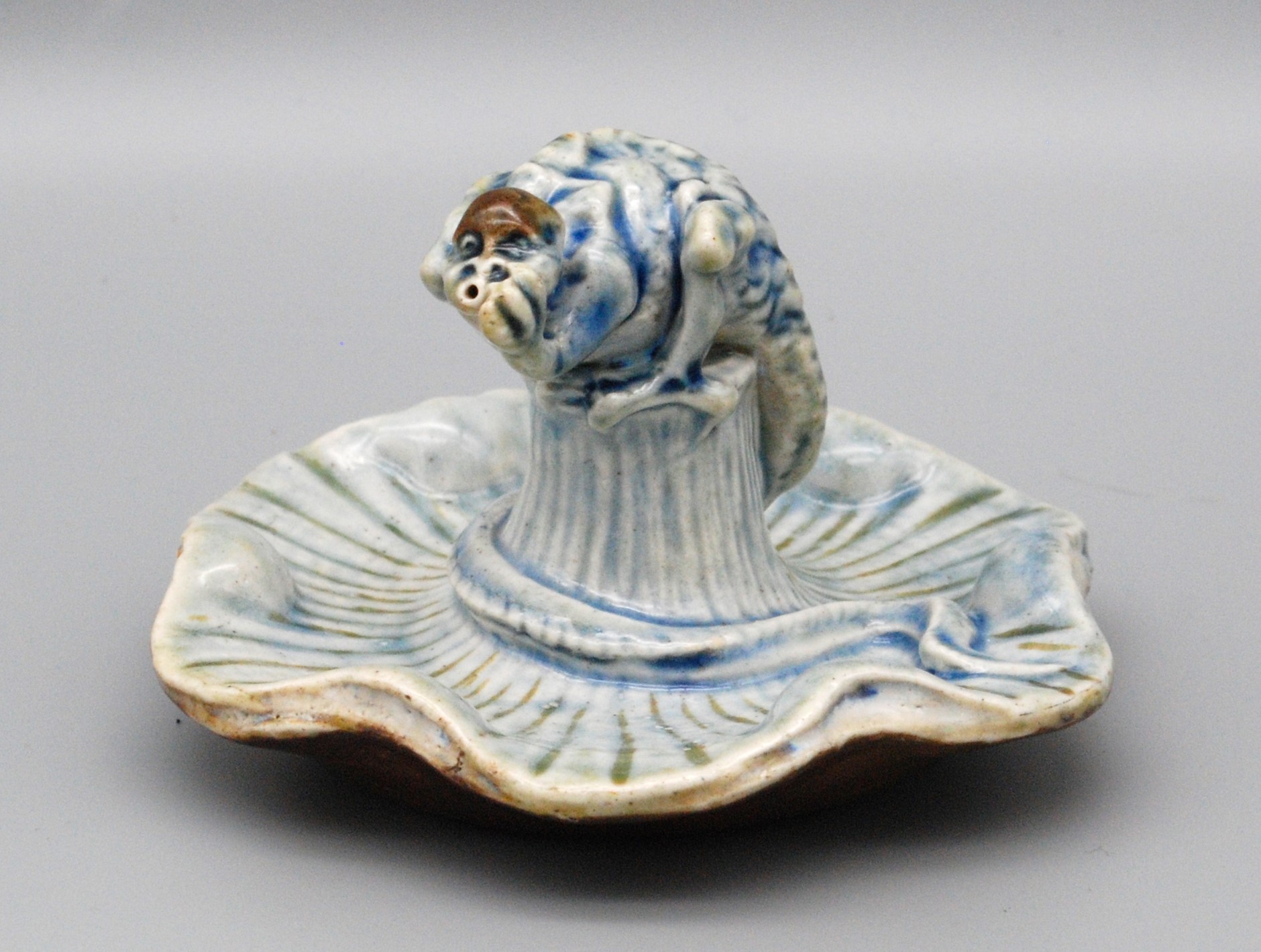
Martin Brothers Grotesque Reptile on Mushroom
What exactly is it?
For sale is this highly unusual and grotesque Martin Brothers reptile sitting on top of an upside down mushroom. Intricately constructed with a body hideous to behold, we have not seen another quite like this piece. The creature, with almost human like face, has a hand to its mouth like it is whistling, whilst its menacing double-taloned feet grip the underside of the mushroom. The body is contorted and detailed as if scaly, the texture brought out by blue against the otherwise pale cream colourway. The creature has a long tail, going down to the base of the mushroom stem and then curling around. The mushroom has long painted green strokes.
Which brother made it?
Likely to have been made by the brother most famed for grotesque, whimsical and macabre creations, Robert Wallace Martin.
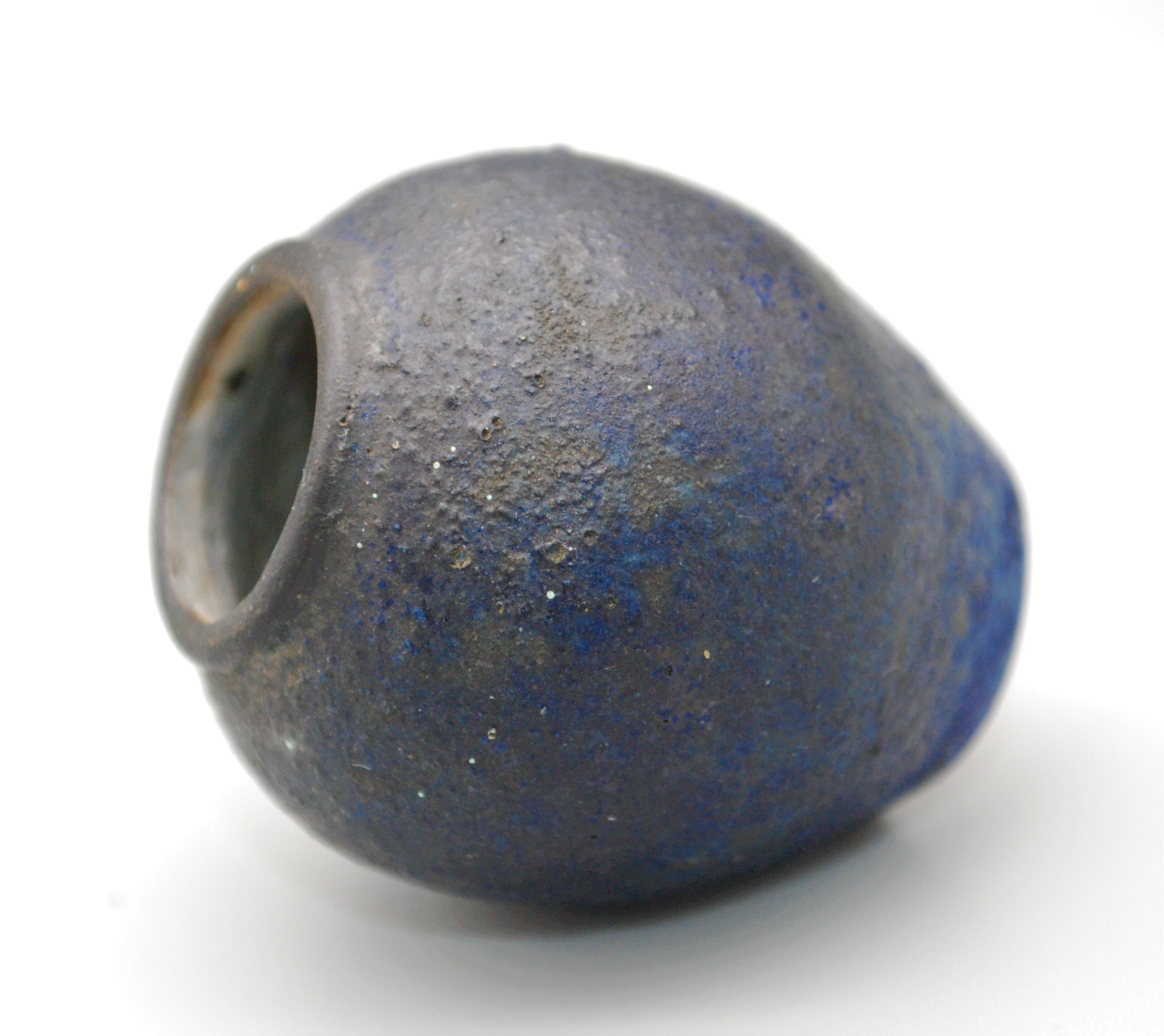
Martin Brothers Miniature Cobalt Blue Vase
For sale is this diminutive vase, likely to have been made by Edwin Martin, the youngest of the Martin Brothers. This vase is tiny – 4cm tall by 3.75cm wide! In low light, one might mistake it as being black, but under light a strong blue shows through. With a delicate little top rim, and traditional rounded shape, it really is a vase in miniature!
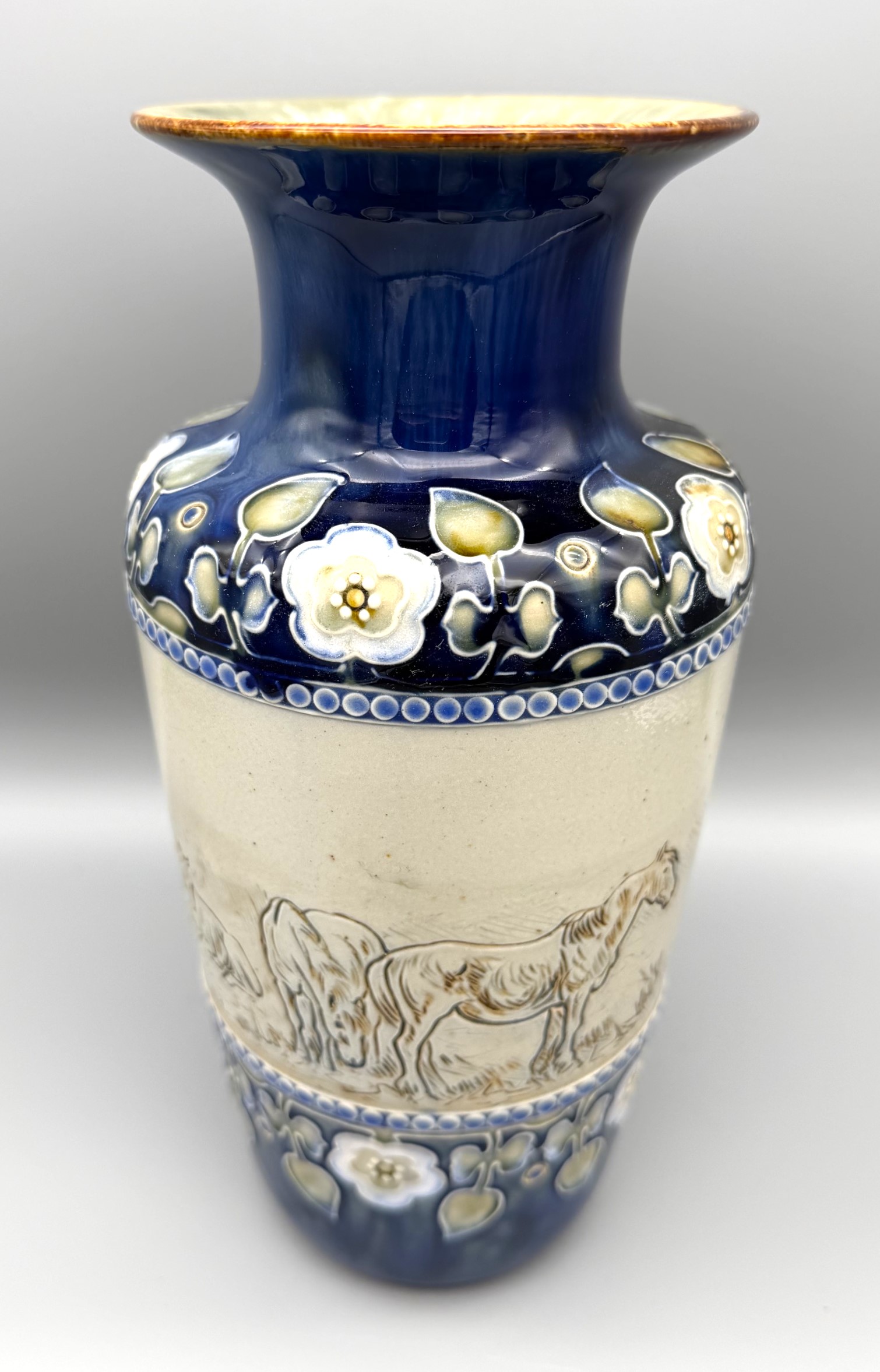
Doulton Lambeth Hannah Barlow Horses Vase
£625.00
Doulton Lambeth Sgraffito Horse Vase | Hannah Barlow & Florence C. Roberts
A superb piece of early 20th-century British Art Pottery. This Doulton Lambeth vase showcases a continuous 360-degree sgraffito scene depicting six horses, foals, and farm buildings. Hand-incised by renowned artist Hannah Barlow, the central band is framed by rich cobalt blue and tubelined floral borders created by artist Florence C. Roberts.
-
Dimensions: 27 cm H × 13 cm W
-
Condition: Perfect, unrestored original condition
-
Marks: Stamped with the Royal Doulton Lambeth mark, incised HBB and FcR artist monograms, and factory series numbers
An extraordinary collector’s piece combining exceptional provenance, rare collaborative artistry, and pristine preservation.
DM for pricing and purchase details!
-
Martin Brothers Early Open Salt
£395.00
Early Martin Brothers Salt-Glazed Open Salt Dish (Circa 1880s)
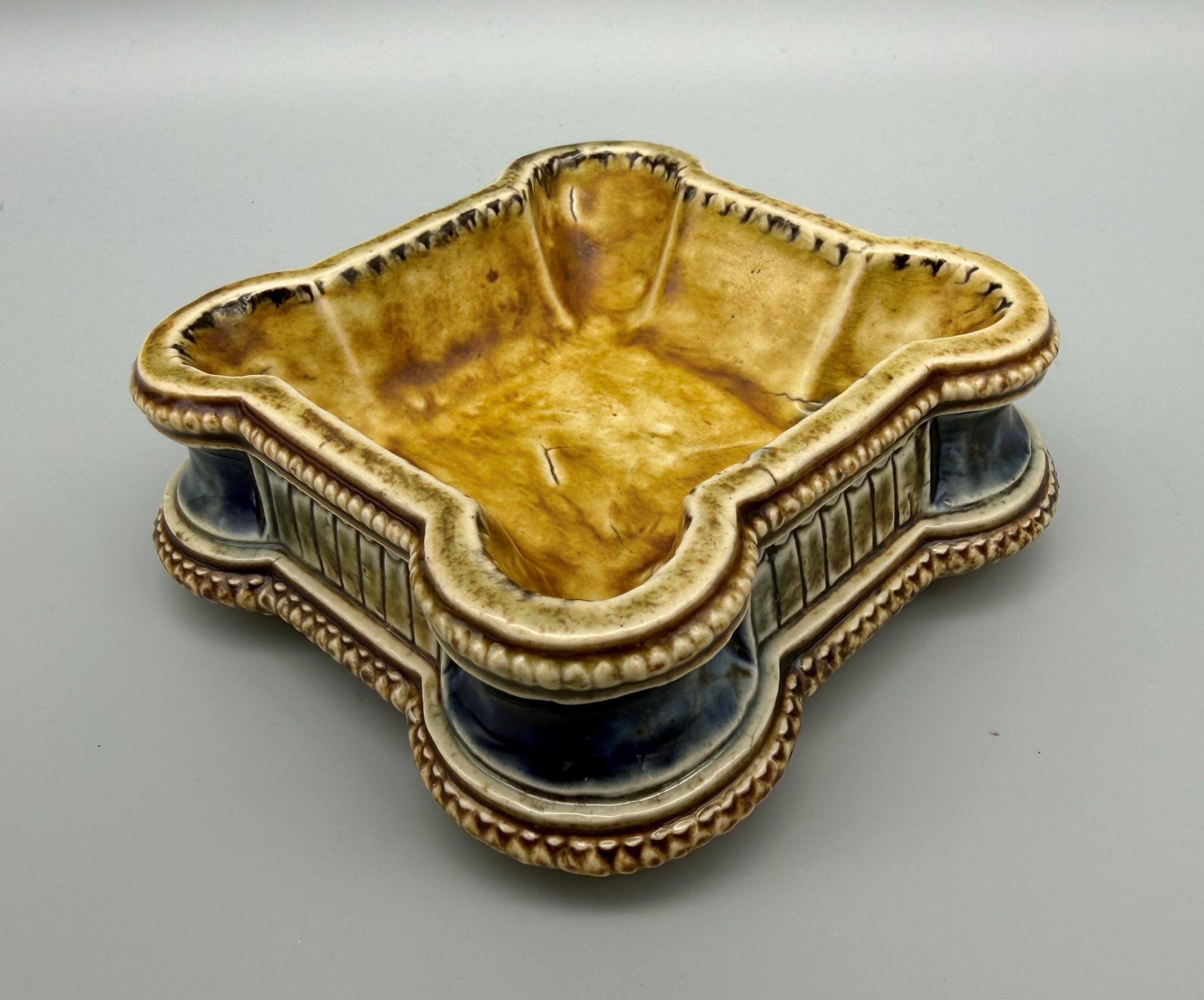
This distinctive open salt dish, crafted by Robert Wallace Martin of the renowned Martin Brothers pottery, dates to the 1880s and represents a superb example of early British art pottery. The piece features a robust, architectural form with a squared, lobed profile resting on four domed feet.
The exterior is defined by tactile detailing, utilizing a raised, beaded border that frames the upper and lower registers. The flat sides showcase a recessed, vertically fluted arcade motif, which contrasts sharply with the smooth, sweeping curves of the prominent corners. A rich, earthy palette characterizes the dish: the interior basin and upper sections are bathed in a mottled ochre and mustard-yellow glaze, while the lower corner sections exhibit a deep, resonant cobalt blue.
The underside bears the clearly incised signature “Martin Bros, London & Southall,” authenticating its early origins. Notably, the base retains a label from the esteemed Whitley Collection, providing highly desirable provenance for the discerning collector.
The dish presents in exceptional, unrestored original condition, free from subsequent damage or repairs. It exhibits small authentic, in-manufacture firing cracks—visible within the interior basin and underside—which are inherent to the early Martin Brothers firing process and do not detract from its structural integrity or historic appeal.
Doulton Lambeth Faience Floral Vase
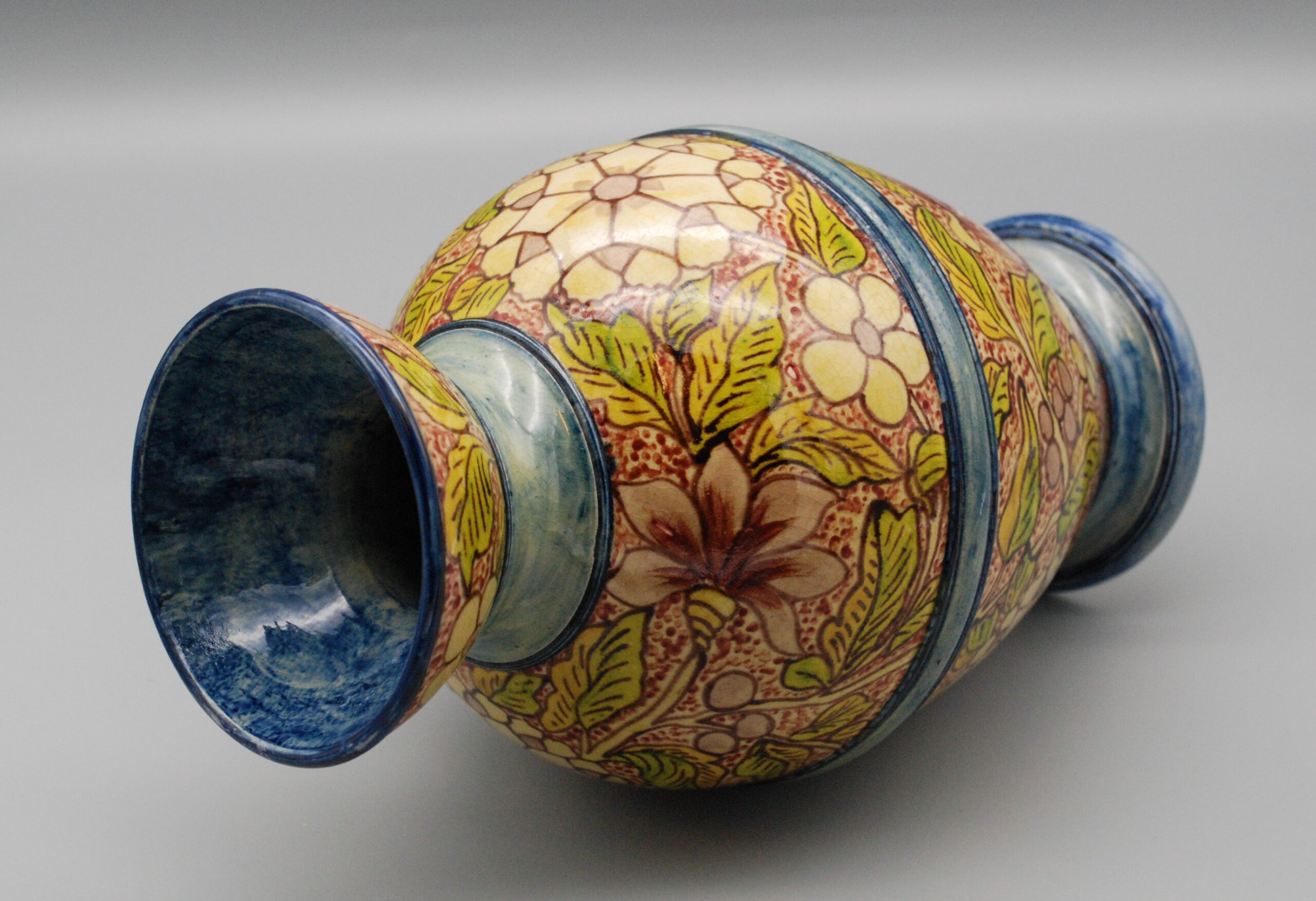
For sale is wonderful early piece of Doulton Lambeth Faience, dated 1875. Decorated by artist Mary Capes, it is what I consider a really bright and joyful piece to behond. Mary has been flamboyant, bringing pink/red hibiscus type florals and smaller yellow flowers into an intricate foliage. Interspersed, are angular, almost kaleidoscope shapes which add real interest to the aesthetic. Borders on the neck narrow, mid-body and foot use different blues to create a wonderful contrast and they keep the piece light and perfect to lift a room.
Standing 23cm tall, and 13cm wide, this is a perfect size for the collector, being flexible and presentable in or out of a lit cabinet.
Beneath are the early oval Doulton Lambeth stamps, 1875, and the painted on initials for Mary Capes. All presents correctly.
Shop Grid- 4 Columnsnickgt12021-03-01T16:55:57+00:00